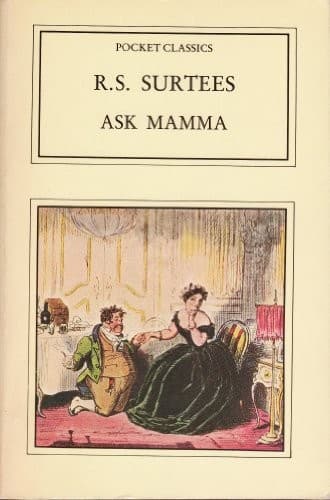
"Ask Mamma"; or, The Richest Commoner In EnglandSurtees, Robert Smith
General
"Ask Mamma"; or, The Richest Commoner In England
Surtees, Robert Smith
England -- Social life and customs -- 19th century -- Fiction; Fox hunting -- Fiction
The dirty-shirted helper had seen them coming; but the servants
generally looking upon Cuddy as a spy, the man had locked the
door upon him.
“Beg pardon, sir,” now said the Catiff, pulling at his cowlick as
he opened it; “beg pardon, sir, didn’t know it was you.”
“Didn’t you,” replied Cuddy, adding, “you might have known by my
knock,” saying which Cuddy stuck his cheesey hat down on his
nose, and pocketing his hands, proceeded to scrutinise the stud.
“What’s this ‘orse got a bandage on for?” asked he about one.
“Why don’t ye let that ‘orse’s ‘ead down?” demanded he of
another. “Strip this ’orse,” ordered he of a third. Then Cuddy
stood criticising his points, his legs, his loins, his hocks, his
head, his steep shoulder, as he called it, and then ordered the
clothes to be put on again. So he went from stable to stable,
just as he does at Tattersall’s on a Sunday, Cuddy being as true
to the “corner” as the needle to the pole, though, like the
children, he looks, but _never_ touches, that is to say, “bids,”
at least not for himself. Our Billy, soon tiring of this
amusement—if, indeed, amusement it can be called—availed himself
of the interregnum caused by the outside passage from one set of
stables to another, to slip away to look after his own horse, of
whose health he suddenly remembered Rougier had spoken
disparagingly in the morning. After some little trouble he found
the Juniper-smelling head groom, snoring asleep among a heap of
horse-cloths before the fire in the saddle-room.
It is said that a man who is never exactly sober is never quite
drunk, and Jack Wetun was one of this order, he was always
running to the “unsophisticated gin-bottle,” keeping up the steam
of excitement, but seldom overtopping it, and could shake himself
into apparent sobriety in an instant. Like most of Sir Moses’s
people, he was one of the fallen angels of servitude, having
lived in high places, from which his intemperate habits had
ejected him; and he was now gradually descending to that last
refuge of the destitute, the Ostlership of a farmer’s inn.
Starting out of his nest at the rousing shake of the helper, who
holloaed in his ear that “Mr. Pringle wanted to see his ‘orse,”
Wetun stretched his brawny arms, and, rubbing his eyes, at length
comprehended Billy, when he exclaimed with a start, “Oss, sir?
Oh, by all means, sir;” and, bundling on his greasy-collared,
iron-grey coat, he reeled and rolled out of the room, followed by
our friend. “That (hiccup) oss of (hiccup) yours is (hiccup)
amiss, I think (hiccup), sir,” said he, leading, or rather
lurching the way. “A w-h-a-w-t?” drawled Billy, watching Weton’s
tack and half-tack gait.
Public-domain text, read in full here on John Shaqi.
Reviews
Reviews
No reviews yet
Be the first to share your thoughts on this work.
Elsewhere in the archive
Join the Discussion
Join the discussion
Sign in to leave a comment or review.
Sign InorCreate an account