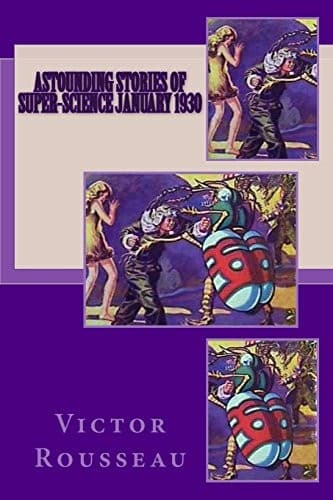
Science fiction -- Periodicals; Science fiction, American -- Periodicals
The gray mist that was fog-gas hung over everything. There was a
definite breeze blowing, but the mist was so dense that it did not seem
to move. It was far enough from the fog-flares for the last least trace
of striation to have vanished. Fifteen miles to the north the fog-flares
were placed, ranged by hundreds and by thousands, burning one after
another as the fog service set them off, and sending out their
incredible masses of thick gray vapor in long threads that spread out
before the wind, coalesced, and made a smoke-screen to which the puny
efforts of the last war--the war that was to make the world safe for
democracy--were as nothing.
Here, fifteen miles down wind from the flares, it was possible to see
clearly in a circle approximately five feet in diameter. At the edge of
that circle outlines began to blur. At ten feet all shapes were the
faintest of bulks, the dimmest of outlines. At fifteen feet all was
invisible, hidden behind a screen of mist.
"Cast around," said Coffee gloomily. "Maybe we'll find a shell, or
tracks of a tank or somethin' that chucked the gas here."
* * * * *
It was rather ludicrous to go searching for anything in that mass of
vapor. At three yards distance they could make each other out as dim
outlines, no more. But it did not even occur to them to deplore the
mist. The war which had already been christened, by the politicians at
home, the last war, was always fought in a mist. Infantry could not
stand against tanks, tanks could not live under aircraft-directed
artillery fire--not when forty guns fired salvos for the aircraft to
spot--and neither artillery nor aircraft could take any advantage of a
victory which either, under special conditions, might win. The general
staffs of both the United States and the prominent nation--let us say
the Yellow Empire--at war with it had come to a single conclusion.
Tanks or infantry were needed for the use of victories. Infantry could
be destroyed by tanks. But tanks could be hidden from aerial spotters by
smoke-screens.
The result was fog-gas, which was being used by both sides in the most
modern fashion when, their own unit wiped out and themselves wandering
aimlessly in the general direction of the American rear, Sergeant Coffee
and Corporal Wallis stumbled upon an American pill-box with its small
garrison lying dead. For forty miles in one direction and perhaps thirty
in the other, the vapor lay upon the earth. It was being blown by the
wind, of course, but it was sufficiently heavier than air to cling to
the ground level, and the industries of two nations were straining every
nerve to supply the demands of their respective armies for its material.
Public-domain text, read in full here on John Shaqi.
Reviews
Reviews
No reviews yet
Be the first to share your thoughts on this work.
Elsewhere in the archive
Join the Discussion
Join the discussion
Sign in to leave a comment or review.
Sign InorCreate an account