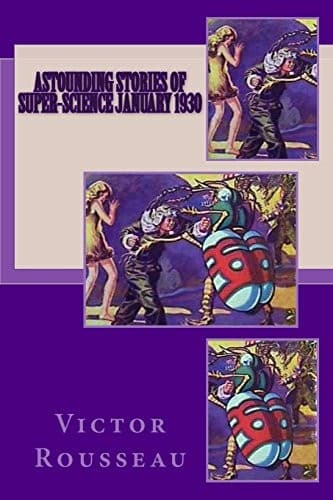
Science fiction -- Periodicals; Science fiction, American -- Periodicals
Mrs. Susan Darrow, the widow, was the paramount witness. She appeared a
quaint figure as she took the stand. Tearful, yet alert, this little
woman betrayed the intelligence that had made her one of the world's
foremost chemists. She gave her age as fifty-eight, but if it had not
been for her snowy hair she would have looked much younger. She was
small but not frail, and had expressive blue eyes. She had a firm little
nose and chin, and was garbed in black silk garments of a fashion
evidently dating back a decade.
Although not modern in dress, her answers to questions regarding
scientific and business affairs involved in the mysterious case, proved
she was thoroughly abreast of the times in all other particulars.
"You believe your husband was murdered?" bluntly asked the examiner at
one stage.
"That is my opinion," she said, then added: "It might have been some
scientific accident, the nature of which I cannot fathom. We were
confidential in all matters except my husband's work. He reserved the
right to be secretive about the scientific problems on which he was
working."
"Can you throw any light on a motive for such a crime?"
"The motive seems self-evident. He was working on an invention that he
said would do away with war and would make the owner of the device a
practical world dictator, should he choose to exercise such power. The
device was completed. The murderer killed him to secure his device. That
all seems plain enough."
"Was anything else of value taken?"
"We had nothing else of value about the place. I was never given to
jewelry. The furnishings and equipment were undisturbed. It is quite
evident, I think, that the thief was no ordinary petty burglar."
* * * * *
The attorney interposed: "I believe we had better let Mrs. Darrow tell
this story from the beginning in her own way. There are only two really
important witnesses. Whatever she can remember to recite might be of
value to the authorities. Now, Mrs. Darrow, how long had you lived at
Brooknook? Begin there and just let your story unfold. Try to control
your nerves and emotions."
"I am not emotional. I am not nervous," said the quaint little woman,
bravely. "My heart hurts, that is all.
"The place was named by my father. We inherited it at his death, thirty
years ago, and moved in. My two children were born and died there. At
first we kept the servants and maintained all of the thirty-two rooms.
But after the children were gone, we both gave ourselves over to study
and we began to close one room after another, releasing the servants one
by one."
"How many rooms do you occupy now?"
"We lived in three, a living-room, kitchen and bedroom. The two big
parlors were turned into a laboratory. We both worked there. It was
there my husband met his death at his work. Sometimes we worked
together, sometimes independently. I did all my own housework, except
the laundry, which I sent out. We had no visitors. We lived for each
other and our work."
Public-domain text, read in full here on John Shaqi.
Reviews
Reviews
No reviews yet
Be the first to share your thoughts on this work.
Elsewhere in the archive
Join the Discussion
Join the discussion
Sign in to leave a comment or review.
Sign InorCreate an account