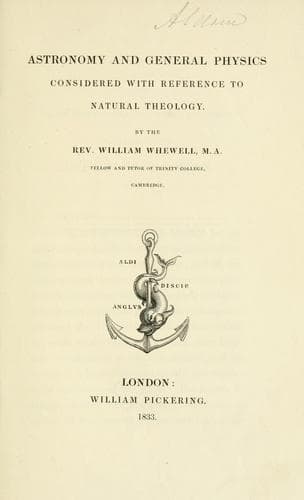
Astronomy and General Physics Considered with Reference to Natural TheologyWhewell, William
Religion
Astronomy and General Physics Considered with Reference to Natural Theology
Whewell, William
Astronomy; Cosmic physics; Natural theology
6. Another theory of the cause of gravity, which at one time
excited considerable notice, was that originally proposed by M.
Le Sage, in a memoir entitled “Lucrece Newtonien,” and further
illustrated by M. Prevost; according to which all space is occupied
by currents of matter, moving perpetually in straight lines, in
all directions, with a vast velocity, and penetrating all bodies.
When two bodies are near each other, they intercept the current
which would flow in the intermediate space if they were not there,
and thus receive a tendency towards each other from the pressure
of the currents on their farther sides. Without examining further
this curious and ingenious hypothesis, we may make upon it the same
kind of observations as before;--that it is perfectly gratuitous,
except as a means of explaining the phenomena; and that, if it were
proved, it would still remain to be shown what necessity has caused
the existence of these _two kinds_ of matter; the first kind being
that which is commonly called matter, and which alone affects our
senses, while it is inert as to any tendency to motion; the second
kind being something imperceptible to our senses, except by the
effects it produces on matter of the former kind; yet exerting an
impulse on every material body, permeating every portion of common
matter, flowing with inconceivable velocity, in inexhaustible
abundance, from every part of the abyss of infinity on one side,
to the opposite part of the same abyss; and so constituted that
through all eternity it can never bend its path, or return, or
tarry in its course.
If we were to accept this theory, it would little or nothing
diminish our wonder at the structure of the universe. We might well
continue to admire the evidence of contrivance, if such a machinery
should be found to produce all the effects which flow from the law
of gravitation.
7. The arguments for and against the necessity of the law of
the inverse square of the distance in the force of gravity,
were discussed with great animation about the middle of the
last century. Clairault, an eminent mathematician, who did
more than almost any other person for the establishment and
development of the Newtonian doctrines, maintained, at one period
of his researches, not only that the inverse square was not the
_necessary_ law, but also that it was not the _true_ law. The
occasion of this controversy was somewhat curious.
Public-domain text, read in full here on John Shaqi.
Reviews
Reviews
No reviews yet
Be the first to share your thoughts on this work.
Elsewhere in the archive
Join the Discussion
Join the discussion
Sign in to leave a comment or review.
Sign InorCreate an account