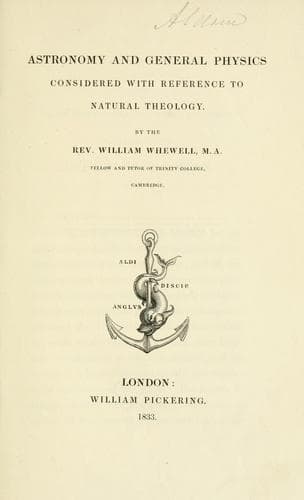
Astronomy and General Physics Considered with Reference to Natural TheologyWhewell, William
Religion
Astronomy and General Physics Considered with Reference to Natural Theology
Whewell, William
Astronomy; Cosmic physics; Natural theology
4. But suppose this flight performed;--we are yet but at the outset
of the progress which must carry us towards Him. We have yet to
begin to learn all that we are to know concerning the ultimate laws
of organized bodies. What is the principle of _life_? What is the
rule of that action of which assimilation, secretion, developement,
are manifestations? and which appears to be farther removed from
mere chemistry than chemistry is from mechanics. And what again is
the new principle, as it seems to be, which is exhibited in the
_irritability_ of an animal nerve? the existence of a sense? How
different is this from all the preceding notions! No efforts can
avoid or conceal the vast but inscrutable chasm. Those theorists,
who have maintained most strenuously the possibility of tracing
the phenomena of animal life to the influence of physical agents,
have constantly been obliged to suppose a mode of agency altogether
different from any yet known in physics. Thus Lamarck, one of
the most noted of such speculators, in describing the course of
his researches, says, “I was soon persuaded that the _internal
sentiment_ constituted a power which it was necessary to take into
account.” And Bichat, another writer on the same subject, while
he declares his dissent from Stahl, and the earlier speculators,
who had referred every thing in the economy of life to a single
principle, which they called the _anima_, the _vital principle_,
and so forth, himself introduces several principles, or laws,
all utterly foreign to the region of physics; namely, _organic
sensibility_, _organic contractility_, _animal sensibility_,
_animal contractility_, and the like. Supposing such principles
really to exist, how far enlarged and changed must our views be
before we can conceive these properties, including the faculty of
perception, which they imply, to be produced by the will and power
of one supreme Being, acting by fixed laws. Yet without conceiving
this, we cannot conceive the agency of that Deity, who is
incessantly thus acting, in countless millions of forms and modes.
How strongly then does science represent God to us as
incomprehensible! his attributes as unfathomable! His power, his
wisdom, his goodness, appear in each of the provinces of nature
which are thus brought before us; and in each, the more we study
them, the more impressive, the more admirable do they appear.
When then we find these qualities manifested in each of so many
successive ways, and each manifestation rising above the preceding
by unknown degrees, and through a progression of unknown extent,
what other language can we use concerning such attributes than that
they are _infinite_? What mode of expression can the most cautious
philosophy suggest, other than that He, to whom we thus endeavour
to approach, is infinitely wise, powerful, and good?
Public-domain text, read in full here on John Shaqi.
Reviews
Reviews
No reviews yet
Be the first to share your thoughts on this work.
Elsewhere in the archive
Join the Discussion
Join the discussion
Sign in to leave a comment or review.
Sign InorCreate an account