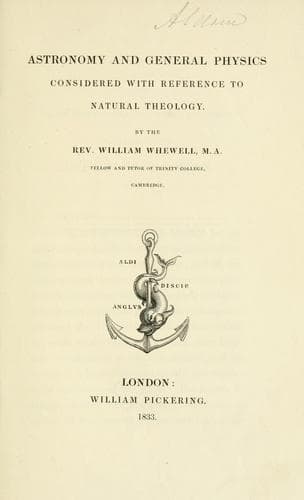
Astronomy and General Physics Considered with Reference to Natural TheologyWhewell, William
Religion
Astronomy and General Physics Considered with Reference to Natural Theology
Whewell, William
Astronomy; Cosmic physics; Natural theology
Another peculiarity in the laws which regulate the action of cold
on water is, that in the very act of freezing a further sudden
and considerable expansion takes place. Many persons will have
known instances of vessels burst by the freezing of water in them.
The consequence of this expansion is, that the specific gravity
of ice is less than that of water of any temperature; and it
therefore always floats in the unfrozen fluid. If this expansion of
crystallization did not exist, ice would float in water which was
below forty degrees, but would sink when the fluid was above that
temperature: as the case is, it floats under all circumstances. The
icy remnants of the effects of winter, which the river carries down
its stream, are visible on its surface till they melt away; and
the icebergs which are detached from the shores of the polar seas,
drift along, exposed to the sun and air, as well as to the water in
which they are immersed.
These laws of the effect of temperature on water are truly
remarkable in their adaptation to the beneficial course of things
at the earth’s surface. Water contracts by cold; it thus equalizes
the temperature of various times and places; but if its contraction
were continued all the way to the freezing point, it would bind a
great part of the earth in fetters of ice. The contraction then
is here replaced by expansion, in a manner which but slightly
modifies the former effects, while it completely obviates the bad
consequences. The further expansion which takes place at the point
of freezing, still further facilitates the rapid removal of the
icy chains, in which parts of the earth’s surface are at certain
seasons bound.
We do not know how far these laws of expansion are connected with
and depend on more remote and general properties of this fluid, or
of all fluids. But we have no reason to believe that, by whatever
means they operate, they are not laws selected from among other
laws which might exist, as in fact for other fluids other laws do
exist. And we have all the evidence, which the most remarkable
furtherance of important purposes can give us, that they _are_
selected, and selected with a beneficial design.
Public-domain text, read in full here on John Shaqi.
Reviews
Reviews
No reviews yet
Be the first to share your thoughts on this work.
Join the Discussion
Join the discussion
Sign in to leave a comment or review.
Sign InorCreate an account