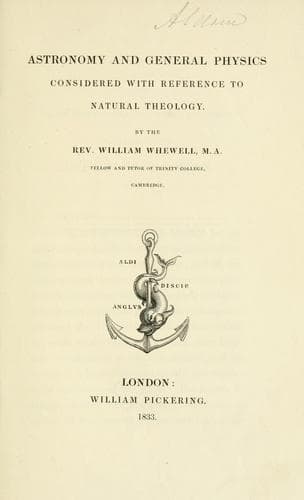
Astronomy and General Physics Considered with Reference to Natural TheologyWhewell, William
Religion
Astronomy and General Physics Considered with Reference to Natural Theology
Whewell, William
Astronomy; Cosmic physics; Natural theology
3. As water becomes ice by cold, it becomes steam by heat. In
common language, steam is the name given to the vapour of _hot_
water; but in fact a vapour or steam rises from water at all
temperatures, however low, and even from ice. The expansive force
of this vapour increases rapidly as the heat increases; so that
when we reach the heat of boiling water, it operates in a far
more striking manner than when it is colder; but in all cases
the surface of water is covered with an atmosphere of aqueous
vapour, the pressure or _tension_ of which is limited by the
temperature of the water. To each degree of pressure in steam there
is a _constituent temperature_ corresponding. If the surface of
water is not pressed by vapour with the force thus corresponding
to its temperature, an immediate _evaporation_ will supply the
deficiency. We can compare the tension of such vapour with that of
our common atmosphere; the pressure of the latter is measured by
the barometrical column, about thirty inches of mercury; that of
watery vapour is equal to one inch of mercury at the constituent
temperature of 80 degrees, and to one-fifth of an inch, at the
temperature of 32 degrees.
Hence, if that part of the atmosphere which consists of common air
were annihilated, there would still remain an atmosphere of aqueous
vapour, arising from the waters and moist parts of the earth; and
in the existing state of things this vapour rises in the atmosphere
of dry air. Its distribution and effects are materially influenced
by the vehicle in which it is thus carried, as we shall hereafter
notice; but at present we have to observe the exceeding _utility_
of water in this shape. We remark how suitable and indispensable to
the well-being of the creation it is, that the fluid should possess
the property of assuming such a form under such circumstances.
The _moisture_ which floats in the atmosphere is of most essential
use to vegetable life.[7] “The leaves of living plants appear to
act upon this vapour in its elastic form, and to absorb it. Some
vegetables increase in weight from this cause when suspended in the
atmosphere and unconnected with the soil, as the house-leek and the
aloe. In very intense heats, and when the soil is dry, the life
of plants seems to be preserved by the absorbent power of their
leaves.” It follows from what has already been said, that, with an
increasing heat of the atmosphere, an increasing quantity of vapour
will rise into it, if supplied from any quarter. Hence it appears
that aqueous vapour is most abundant in the atmosphere when it is
most needed for the purposes of life; and that when other sources
of moisture are cut off, this is most copious.
Public-domain text, read in full here on John Shaqi.
Reviews
Reviews
No reviews yet
Be the first to share your thoughts on this work.
Elsewhere in the archive
Join the Discussion
Join the discussion
Sign in to leave a comment or review.
Sign InorCreate an account