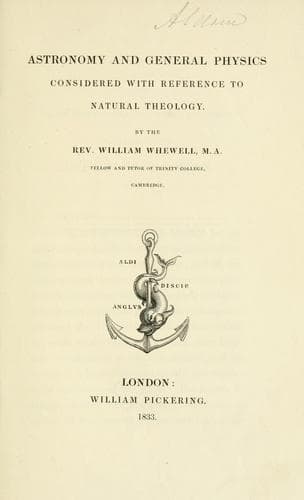
Astronomy and General Physics Considered with Reference to Natural TheologyWhewell, William
Religion
Astronomy and General Physics Considered with Reference to Natural Theology
Whewell, William
Astronomy; Cosmic physics; Natural theology
6. Returning back still further in the changes which cold can
produce on water, we come to _snow_ and _ice_: snow being
apparently frozen vapour, aggregated by a confused action of
crystalline laws; and ice being water in its fluid state,
solidified by the same crystalline forces. The impression of
these agents on the animal feelings is generally unpleasant,
and we are in the habit of considering them as symptoms of the
power of winter to interrupt that state of the elements in which
they are subservient to life. Yet, even in this form, they are
not without their uses.[8] “Snow and ice are bad conductors of
cold; and when the ground is covered with snow, or the surface
of the soil or of water is frozen, the roots or bulbs of plants
beneath are protected by the congealed water from the influence
of the atmosphere, the temperature of which, in northern winters,
is usually very much below the freezing point; and this water
becomes the first nourishment of the plant in early spring. The
expansion of water during its congelation, at which time its volume
increases one-twelfth, and its contraction in bulk during a thaw,
tend to pulverize the soil, to separate its parts from each other,
and to make it more permeable to the influence of the air.” In
consequence of the same slowness in the conduction of heat which
snow thus possesses, the arctic traveller finds his bed of snow
of no intolerable coldness; the Esquimaux is sheltered from the
inclemency of the season in his snow hut, and travels rapidly and
agreeably over the frozen surface of the sea. The uses of those
arrangements, which at first appear productive only of pain and
inconvenience, are well suited to give confidence and hope to our
researches for such usefulness in every part of the creation. They
have thus a peculiar value in adding connexion and universality to
our perception of beneficial design.
7. There is a peculiar circumstance still to be noticed in the
changes from ice to water and from water to steam. These changes
take place at a particular and invariable degree of heat; yet
they do not take place suddenly when we increase the heat to this
degree. This is a very curious arrangement. The temperature _makes
a stand_, as it were, at the point where thaw, and where boiling
take place. It is necessary to apply a considerable quantity of
heat to produce these effects; all which heat disappears, or
becomes _latent_, as it is called. We cannot raise the temperature
of a thawing mass of ice till we have thawed the whole. We cannot
raise the temperature of boiling water, or of steam rising from it,
till we have converted all the water into steam. Any heat that we
apply while these changes are going on is absorbed in producing the
changes.
Public-domain text, read in full here on John Shaqi.
Reviews
Reviews
No reviews yet
Be the first to share your thoughts on this work.
Elsewhere in the archive
Join the Discussion
Join the discussion
Sign in to leave a comment or review.
Sign InorCreate an account