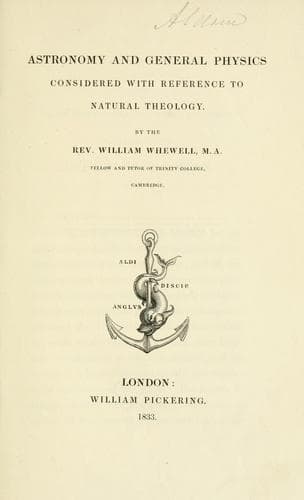
Astronomy and General Physics Considered with Reference to Natural TheologyWhewell, William
Religion
Astronomy and General Physics Considered with Reference to Natural Theology
Whewell, William
Astronomy; Cosmic physics; Natural theology
4. _Clouds_ are produced by aqueous vapour when it returns to the
state of water. This process is _condensation_, the reverse of
evaporation. When vapour exists in the atmosphere, if in any manner
the temperature becomes lower than the _constituent temperature_,
requisite for the maintenance of the vapoury state, some of the
steam will be condensed and will become water. It is in this manner
that the curl of steam from the spout of a boiling tea-kettle
becomes visible, being cooled down as it rushes to the air. The
steam condenses into a fine watery powder, which is carried about
by the little aerial currents. Clouds are of the same nature with
such curls, the condensation being generally produced when air,
charged with aqueous vapour, is mixed with a colder current, or has
its temperature diminished in any other manner.
Clouds, while they retain that shape, are of the most essential
use to vegetable and animal life. They moderate the fervour of
the sun, in a manner agreeable, to a greater or less degree, in
all climates, and grateful no less to vegetables than to animals.
Duhamel says that plants grow more during a week of cloudy weather
than a month of dry and hot. It has been observed that vegetables
are far more refreshed by being watered in cloudy than in clear
weather. In the latter case, probably the supply of fluid is too
rapidly carried off by evaporation. Clouds also moderate the
alternations of temperature, by checking the radiation from the
earth. The coldest nights are those which occur under a cloudless
winter sky.
The uses of clouds, therefore, in this stage of their history,
are by no means inconsiderable, and seem to indicate to us that
the laws of their formation were constructed with a view to the
purposes of organized life.
5. Clouds produce _rain_. In the formation of a cloud the
precipitation of moisture probably forms a fine watery _powder_,
which remains suspended in the air in consequence of the minuteness
of its particles: but if from any cause the precipitation is
collected in larger portions, and becomes _drops_, these descend by
their weight and produce a shower.
However rain is formed, it is one of the consequences of the
capacity of evaporation and condensation which belongs to water,
and its uses are the result of the laws of those processes. Its
uses to plants are too obvious and too numerous to be described. It
is evident that on its quantity and distribution depend in a great
measure the prosperity of the vegetable kingdom: and different
climates are fitted for different productions, no less by the
relations of dry weather and showers, than by those of hot and cold.
Public-domain text, read in full here on John Shaqi.
Reviews
Reviews
No reviews yet
Be the first to share your thoughts on this work.
Elsewhere in the archive
Join the Discussion
Join the discussion
Sign in to leave a comment or review.
Sign InorCreate an account