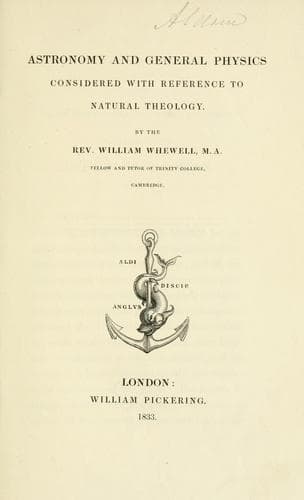
Astronomy and General Physics Considered with Reference to Natural TheologyWhewell, William
Religion
Astronomy and General Physics Considered with Reference to Natural Theology
Whewell, William
Astronomy; Cosmic physics; Natural theology
8. Another office of water which it discharges by means of its
relations to heat, is that of supplying our _springs_. There can be
no doubt that the old hypotheses which represent springs as drawing
their supplies from large subterranean reservoirs of water, or from
the sea by a process of subterraneous filtration, are erroneous
and untenable. The quantity of evaporation from water and from wet
ground is found to be amply sufficient to supply the requisite
drain. Mr. Dalton calculated[9] that the quantity of rain which
falls in England is thirty-six inches a year. Of this he reckoned
that thirteen inches flow off to the sea by the rivers, and that
the remaining twenty-three inches are raised again from the ground
by evaporation. The thirteen inches of water are of course supplied
by evaporation from the sea, and are carried back to the land
through the atmosphere. Vapour is perpetually rising from the
ocean, and is condensed in the hills and high lands, and through
their pores and crevices descends, till it is deflected, collected,
and conducted out to the bay, by some stratum or channel which is
watertight. The condensation which takes place in the higher parts
of the country, may easily be recognised in the mists and rains
which are the frequent occupants of such regions. The coldness of
the atmosphere and other causes precipitate the moisture in clouds
and showers, and in the former as well as in the latter shape, it
is condensed and absorbed by the cool ground. Thus a perpetual and
compound circulation of the waters is kept up; a narrower circle
between the evaporation and precipitation of the land itself,
the rivers and streams only occasionally and partially forming a
portion of the circuit; and a wider interchange between the sea and
the lands which feed the springs, the water ascending perpetually
by a thousand currents through the air, and descending by the
gradually converging branches of the rivers, till it is again
returned into the great reservoir of the ocean.
In every country, these two portions of the aqueous circulation
have their regular, and nearly constant, proportion. In this
kingdom the relative quantities are, as we have said, twenty-three
and thirteen. A due distribution of these circulating fluids in
each country appears to be necessary to its organic health; to the
habits of vegetables, and of man. We have every reason to believe
that it is kept up from year to year as steadily as the circulation
of the blood in the veins and arteries of man. It is maintained by
a machinery very different, indeed, from that of the human system,
but apparently as well, and, therefore, we may say as clearly, as
that, adapted to its purposes.
Public-domain text, read in full here on John Shaqi.
Reviews
Reviews
No reviews yet
Be the first to share your thoughts on this work.
Elsewhere in the archive
Join the Discussion
Join the discussion
Sign in to leave a comment or review.
Sign InorCreate an account