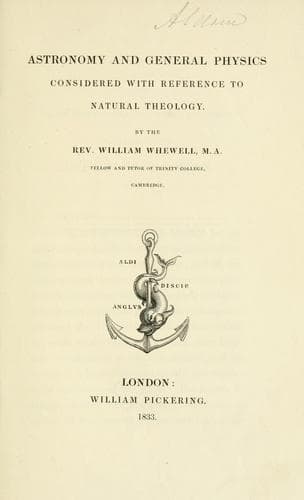
Astronomy and General Physics Considered with Reference to Natural TheologyWhewell, William
Religion
Astronomy and General Physics Considered with Reference to Natural Theology
Whewell, William
Astronomy; Cosmic physics; Natural theology
Undoubtedly it is exceedingly possible that these differences of
light may operate in some quarter, and in some way, which we cannot
detect; and that these laws may have purposes and may answer ends
of which we have no suspicion. All the analogy of nature teaches
us a lesson of humility, with regard to the reliance we are to
place on our discernment and judgment as to such matters. But with
our present knowledge, we may observe, that this curious system of
phenomena appears to be a collateral result of the mechanism by
which the effects of light are produced; and therefore a necessary
consequence of the existence of that element of which the offices
are so numerous and so beneficent.
The new properties of light, and the speculations founded upon
them, have led many persons to the belief of the undulatory theory;
which, as we have said, is considered by some philosophers as
demonstrated. If we adopt this theory, we consider the luminiferous
ether to have no local motion; and to produce refraction and
reflexion by the operation of its elasticity alone. We must
necessarily suppose the tenuity of the ether to be extreme; and
if we moreover suppose its tension to be very great, which the
vast velocity of light requires us to suppose, the vibrations by
which light is propagated will be _transverse_ vibrations, that
is the motion to and fro will be athwart the line along which the
undulation travels; and from this circumstance all the laws of
polarisation necessarily follow. And the properties of transverse
vibrations, combined with the properties of vibrations in general,
give rise to all the curious and numerous phenomena of colours of
which we have spoken.
If the vibrations be transverse, they may be resolved into two
different planes; this is _polarisation_: if they fall on a
medium which has different elasticity in different directions,
they will be divided into two sets of vibrations; this is _double
refraction_; and so on. Some of the new properties, however, as the
fringes of shadows and the colours of thin plates, follow from the
undulatory theory, whether the vibrations be transverse or not.
It would appear, therefore, that the propagation of light by
means of a subtle medium, leads necessarily to the extraordinary
collection of properties which have recently been discovered; and,
at any rate, its propagation by the transverse vibrations of such a
medium does lead inevitably to these results.
Public-domain text, read in full here on John Shaqi.
Reviews
Reviews
No reviews yet
Be the first to share your thoughts on this work.
Elsewhere in the archive
Join the Discussion
Join the discussion
Sign in to leave a comment or review.
Sign InorCreate an account