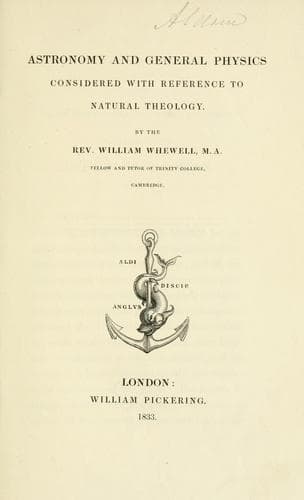
Astronomy and General Physics Considered with Reference to Natural TheologyWhewell, William
Religion
Astronomy and General Physics Considered with Reference to Natural Theology
Whewell, William
Astronomy; Cosmic physics; Natural theology
In what has just been said, we have spoken of light, only with
respect to its power of illuminating objects, and conveying the
impression of them to the eye. It possesses, however, beyond all
doubt, many other qualities. Light is intimately connected with
heat, as we see in the case of the sun and of flame; yet it is
clear that light and heat are not identical. Light is evidently
connected too with electricity and galvanism; and perhaps, through
these, with magnetism: it is, as has already been mentioned,
indispensably necessary to the healthy discharge of the functions
of vegetable life; without it plants cannot duly exercise their
vital powers: it manifests also chemical action in various ways.
The luminiferous _ether_ then, if we so call the medium in which
light is propagated, must possess many other properties besides
those mechanical ones on which the illuminating power depends. It
must not be merely like a fluid poured into the vacant spaces and
interstices of the material world, and exercising no action on
objects; it must affect the physical, chemical and vital powers of
what it touches. It must be a great and active agent in the work
of the universe, as well as an active reporter of what is done
by other agents. It must possess a number of complex and refined
contrivances and adjustments which we cannot analyze, bearing upon
plants and chemical compounds, and the imponderable agents; as well
as those laws which we conceive that we have analyzed, by which it
is the vehicle of illumination and vision.
We have had occasion to point out how complex is the machinery of
the atmosphere, and how varied its objects; since, besides being
the means of communication as the medium of sound, it has known
laws which connect it with heat and moisture; and other laws, in
virtue of which it is decomposed by vegetables. It appears, in
like manner, that the ether is not only the vehicle of light,
but has also laws, at present unknown, which connect it with
heat, electricity, and other agencies; and other laws through
which it is necessary to vegetables, enabling them to decompose
air. All analogy leads us to suppose that if we knew as much of
the constitution of the luminiferous ether as we know of the
constitution of the atmosphere, we should find it a machine as
complex and artificial, as skilfully and admirably constructed.
We know at present very little indeed of the construction of this
machine. Its _existence_ is, perhaps, satisfactorily made out;
in order that we may not interrupt the progress of our argument,
we shall refer to other works for the reasonings which appear to
lead to this conclusion. But whether heat, electricity, galvanism,
magnetism, be fluids; or effects or modifications of fluids; and
whether such fluids or _ethers_ be the same with the luminiferous
ether, or with each other; are questions of which all or most
appear to be at present undecided, and it would be presumptuous and
premature here to take one side or the other.
Public-domain text, read in full here on John Shaqi.
Reviews
Reviews
No reviews yet
Be the first to share your thoughts on this work.
Elsewhere in the archive
Join the Discussion
Join the discussion
Sign in to leave a comment or review.
Sign InorCreate an account