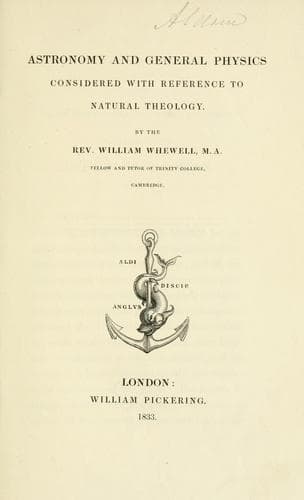
Astronomy and General Physics Considered with Reference to Natural TheologyWhewell, William
Religion
Astronomy and General Physics Considered with Reference to Natural Theology
Whewell, William
Astronomy; Cosmic physics; Natural theology
Supposing the attraction of a planet towards the sun to exist, if
the planet were put in motion in any part of the solar system, it
would describe about the sun an orbit _of some kind_; it might
be a long oval, or a shorter oval, or an exact circle. But if
we suppose the result left to chance, the chances are infinitely
against the last mentioned case. There is but one circle; there
are an infinite number of ovals. Any original impulse would give
some oval, but only one particular impulse, determinate in velocity
and direction, will give a circle. If we suppose the planet to be
originally _projected_, it must be projected perpendicularly to
its distance from the sun, and with a certain precise velocity, in
order that the motion may be circular.
In the basin to which we have compared the solar system, the
adjustment requisite to produce circular motion would require us
to project our pellet so that after running half round the surface
it should touch a point exactly at an equal distance from the
centre, on the other side, passing neither too high nor too low.
And the pellet, it may be observed, should be in size only one
ten thousandth part of the distance from the centre, to make the
dimensions correspond with the cast of the earth’s orbit. If the
mark were set up and hit, we should hardly attribute the result to
chance.
The earth’s orbit, however, is not exactly a circle. The mark is
not precisely a single point, but is a space of the breadth of one
thirtieth of the distance from the centre. Still this is much too
near an agreement with the circle to be considered as the work of
chance. The chances were great against the ball passing so nearly
at the same distance, for there were twenty-nine equal spaces
through which it might have gone, between the mark and the centre,
and an indefinite number outside the mark.
But it is not the earth’s orbit alone which is nearly a circle:
the rest of the planets also approach very nearly to that form:
Venus more nearly still than the earth: Jupiter, Saturn, and Uranus
have a difference of about one tenth, between their greatest and
least distances from the sun: Mars has his extreme distances in the
proportion of five to six nearly; and Mercury in the proportion of
two to three. The last mentioned case is a considerable deviation,
and two of the small planets which lie between Mars and Jupiter,
namely Juno and Pallas, exhibit an inequality somewhat greater
still; but the smallness of these bodies, and other circumstances,
make it probable that there may be particular causes for the
exception in their case. The orbits of the satellites of the Earth,
of Jupiter and of Saturn, are also nearly circular.
Public-domain text, read in full here on John Shaqi.
Reviews
Reviews
No reviews yet
Be the first to share your thoughts on this work.
Elsewhere in the archive
Join the Discussion
Join the discussion
Sign in to leave a comment or review.
Sign InorCreate an account