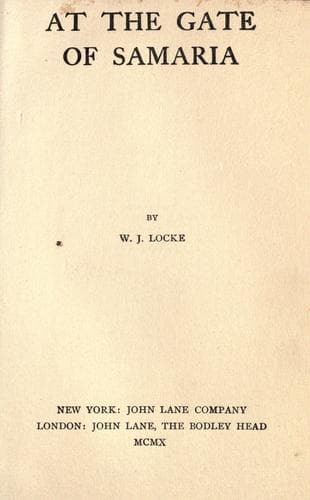
London (England) -- Fiction; Man-woman relationships -- Fiction; Women artists -- Fiction
“Oh, dear!” sighed Mr. Singleton, clasping his little plump hands
resignedly. “Are we still to adore the well-conducted person who goes on
cutting bread and butter? Oh, believe me, Edwin Smith and Angelina
Brown can't love, any more than they can appreciate Château-Mouton.
They possess for each other a faint current of sexual attraction, which
produces between them a mild excess of amiability. A lot of vanity
comes in, as they like to parade the possession of each other before
the envious. They call themselves lovers, and follow the traditions they
have been taught in the novels they have misunderstood and the hints
they have received from observance of their friends. The furthest they
can go is to clasp hands limply under a sofa-cushion, when they think no
one is looking.”
“That's humbug,” said the youth. “I have been in love myself.”
“Precisely,” said Mr. Singleton, “and you know nothing at all about it.
Cultivate all your senses first, my young friend, and then you may fit
yourself for falling in love.”
“And how is one to begin?” asked Mrs. Tredegar.
“Well, first cultivate a choice taste in food, wine, and cigarettes.
Then disabuse yourself of the idea that the angelic, either in man or
woman, is in any way desirable; purge yourself of that clog to all true
appreciation of sensation--that interfering bugbear which still survives
with an effete superstition--known as a conscience; get into an Hellenic
state of mind by joyous perception of the beautiful, and realise
that the supreme cultivation of the _ego_ is the _ultima ratio_ of
existence.”
“But then we should only love ourselves,” observed a dissentient.
“As self-knowledge is the beginning of all wisdom, so is self-love the
beginning of all passion,” returned Mr. Singleton oracularly.
During the frivolous chorus that followed this remark, Hammerdyke
crossed the room and sat down by Clytie's side.
“You seem to be very merry over here. What is it all about?” he asked.
“It's only Mr. Singleton trying to play with paradoxes,” Clytie replied,
laughing. “He is a chartered libertine, and nobody minds him.”
“That always strikes me as so odd when I get back to civilised life--the
tremendous amount of talking one has to get through--and no one seems to
get any further with it. Everybody seems bound to provide himself with
a theory of life, as they call it--either sincere or paradoxical. Why do
they do it?”
He had pulled his chair a little aside, so that, when Clytie turned
round, they were cut off from the main group close by. She replied
laughingly to his question, and the conversation took a light, personal
turn.
“I seem to have known you so long,” he said after a while, “and yet this
is the first time I have been able to say a word to you by yourself. I
used to hear of you, you know, in Africa, when Caroline sent me a budget
of news. I used quite to wonder what you were like.”
“Caroline and I are great friends,” she replied. “She has been very,
very kind to me.”
Public-domain text, read in full here on John Shaqi.
Reviews
Reviews
No reviews yet
Be the first to share your thoughts on this work.
Elsewhere in the archive
Join the Discussion
Join the discussion
Sign in to leave a comment or review.
Sign InorCreate an account