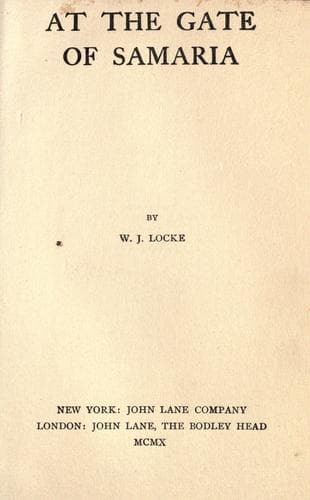
London (England) -- Fiction; Man-woman relationships -- Fiction; Women artists -- Fiction
In a few moments it was over. The words compromising a lifetime had been
said. The wedding ring gleamed upon her finger. As she passed with the
others into the vestry she looked down at it in a daze. There it was and
there it must remain till death parted them, a token of submission and
obedience. In the vestry there were embraces, congratulations. Thornton
kissed her after the gallant fashion of a man who can afford to wait for
a warmer caress. Winifred threw her arms round her neck, weeping. Mrs.
Farquharson kissed her in her affectionate, motherly way. George kissed
her gravely on the forehead and dipped the pen in the ink for her to
sign “Clytie Davenant” for the last time. Then they found themselves in
the porch again, saying farewell. Caroline laughingly called her “Mrs.
Hammerdyke” as they finally parted. And then the little knot of three
waved their handkerchiefs as the cab drove off that took her husband and
herself towards Victoria.
“You are mine now, my darling,” he said, taking her hand. “All that is
most mine.”
“I am glad,” she murmured, returning his pressure. “Yours for always.”
The commissionnaire met them at the station. He had taken their tickets,
settled their luggage, engaged a carriage. A bouquet of violets lay upon
the seat. Clytie flashed a quick glance at her husband.
“Thank you for thinking. I love them so much.”
He arranged her hot-water can and her rugs and sat down by her side,
thrusting up the dividing arms impatiently. As soon as the train had
moved out of the station he put his arms around her and kissed her, and
spoke to her in tender, passionate words. The stop at Croydon broke the
continuity of this first wedded embrace. On the platform outside
the carriage window a loud altercation was in progress between the
ticket-collector and a young couple who objected to pay for the ticket
of a tiny terrier the woman was carrying. They were of the lower middle
class, both in their Sunday clothes. She was a fair, delicate woman of
some refinement; but the husband was coarse, vulgar, with the stamp
of sensuality on his sharp, somewhat handsome face. Moreover, he
was slightly intoxicated, and used a foul expression to qualify the
collector after the official had departed. A flush rose to the young
woman's forehead.
“Don't, John,” she pleaded. “He's in his rights.”
But the cad consigned his rights to perdition, and moved off vulgarly
proclaiming his own.
Clytie had heard this small scene in a life's drama and she vividly
constructed the miserable tragedy. When the train moved on again she
shivered, with a nameless, indefinable sense of fear. Three months ago
she would have noted the scene for vigorous transference to canvas. Now
the woman more than the artist was stirred.
“Please don't talk--just for a little, Thornton,” she said as he began
to speak.
He looked at her somewhat reproachfully. She drew off her glove and put
her hand into his.
Public-domain text, read in full here on John Shaqi.
Reviews
Reviews
No reviews yet
Be the first to share your thoughts on this work.
Elsewhere in the archive
Join the Discussion
Join the discussion
Sign in to leave a comment or review.
Sign InorCreate an account