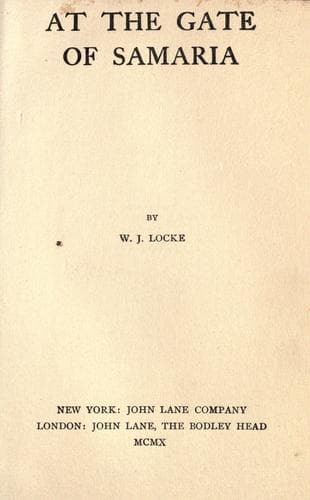
London (England) -- Fiction; Man-woman relationships -- Fiction; Women artists -- Fiction
“But you don't regret it, do you, Thornton?” she asked, womanlike.
“Look at me and see if I do,” he said.
Clytie obeyed him, half shyly, feeling, as she always did since her
return to Paris, the fascination, half pleasant, half painful, of his
eyes. He loved her. There was no doubt of that. Yet the nature of his
love sometimes frightened her a little if she strayed for a moment
off the “love plane.” Her own responsiveness she never questioned,
preferring to shut her eyes and let the current of his love carry her
whither it would. But at times now, during her solitary walks through
the Louvre, the thought obtruded, What would the new life be like?
Not these early days, which were holidays from the seriousnesses of
existence, but the life in the years that lay before her, of whose
responsibilities she had as yet but vague premonitions. How would her
art be affected?
Would it lose or gain in that breadth and insight that it needed? Would
she continue to reckon herself an artist at all, or would she only
degenerate into the amateur--painting little meaningless pictures for
amusement? And at the end of a year would she not stand face to face
with a new Clytie, paler, more shadowy, and therefore less insistently
demanding self-expression? Even these few weeks had changed her: what
would she be at the end of one year, two years, twenty years? Happier,
with all her old cravings satisfied, with her individuality worked out
to its fullest, with the riddle of life joyously solved? Or else----She
scarcely dared think of it. She looked at what had been written in
her Book of New Formulas, and found that the marriage service had been
omitted. It merely said that marriage was unformularisable, an easy way
of curving a contumelious lip at the old formulas which she had rebelled
against, but scarcely satisfactory in her present position. Now, in the
Old Formulas, marriage was minutely, scrupulously regulated by the
most definite of rules. Although they broke up the poem of life into a
disjointed copy-book, or at best into a collection of elegant extracts,
still they presented a homogeneous scheme. Should she at last have
to accept this, confess to Mrs. Blather smiling complacently that the
Durdleham philosophy was the only one? But then she would look at her
husband and take a measure of comfort. Such a man could not come out of
Durdleham.
That was her consolation in the perplexities that the problem of her
married life caused her. She took refuge from herself, her thoughts,
her forebodings, in his grand strength and personal magnetism. It was
intermittent intoxication, this long Paris after-honeymoon, rather than
continuous charm, and the intervals of soberness had their wearinesses.
She had thrown her cap over the windmills. Sometimes she regretted it.
Public-domain text, read in full here on John Shaqi.
Reviews
Reviews
No reviews yet
Be the first to share your thoughts on this work.
Elsewhere in the archive
Join the Discussion
Join the discussion
Sign in to leave a comment or review.
Sign InorCreate an account