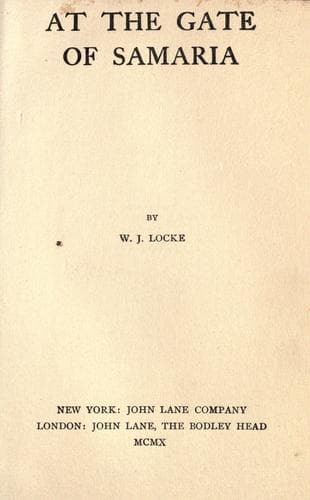
London (England) -- Fiction; Man-woman relationships -- Fiction; Women artists -- Fiction
Mrs. Blather was anxious that Clytie and her husband should come to
Durdleham to stay there after the season in town was over. But Clytie
replied evasively to the affectionate invitation. She shrank from
Durdleham even more than from herself. Mrs. Blather, now that the
soreness as regards the wedding had worn off, was delighted at the
brilliant match--just the very marriage one could have wished for
Clytie, as she remarked over the Durdleham tea tables. Besides, it
was definite settling down for Clytie, saving them from that shadow of
scandal that had always seemed liable to be cast over them through her
unprincipled behaviour. There were no longer any fears. And Mrs. Blather
had her own little triumph in another way. She remembered now she had
prophesied years ago that Clytie's desire to live her art life in London
was a craze that would not last long--like Janet's transient enthusiasm
for cookery classes. Both Janet and herself took it for granted that
Clytie viewed her past errors with the same indulgent retrospective
smile, and wrote her complacent letters based on this assumption. And
Clytie found it harder than ever to write to them naturally, to answer
these letters in the same tone. If her sisters had failed to understand
her when to her her young, earnest self was brightly intelligible, how
could they do it now when she saw herself vaguely, dimly, wrapped in
impenetrable vapours? A visit to Durdleham, under the circumstances,
seemed almost an ordeal. Yet Thornton's presence there might make some
difference.
She spoke to him very little on the subject. He broached it himself one
day at breakfast, almost the only time now, except late at night, that
she saw him alone. It was nearing the end of July and the session of
Parliament was on the eve of closing.
“When are you going to see your people, Clytie?” he asked, looking over
his paper.
“I thought I had told you. They want us to come for a week as soon as we
can leave town.”
“Us?”
“Yes; won't you come?”
“Oh, no, thanks. It would not suit me at all. You go and make an excuse
for me.”
“Things are not gay there, I know,” said Clytie, “but I should like you
to come with me.”
“It can't be done, my dear,” replied Thornton. “You had better have a
quiet time there by yourself, while I go up to Scotland----”
“I thought you would have liked me to go to Scotland with you--we have
seen so little of each other lately. You don't want to stay up there all
the autumn without me?” she added half pathetically.
“Why, my dear Clytie, you can come if you like,” said her husband,
drawing back his chair from the table. “Only you won't find much fun in
a little shooting-box in the middle of a glen in the Highlands. Look:
you go and see your people for a month, and then, if you like, you can
come and join me there--that is to say, if Carteret has any of his women
folks staying in the house, which does not seem to be quite settled yet.
If he hasn't, naturally you can't come.”
Public-domain text, read in full here on John Shaqi.
Reviews
Reviews
No reviews yet
Be the first to share your thoughts on this work.
Elsewhere in the archive
Join the Discussion
Join the discussion
Sign in to leave a comment or review.
Sign InorCreate an account