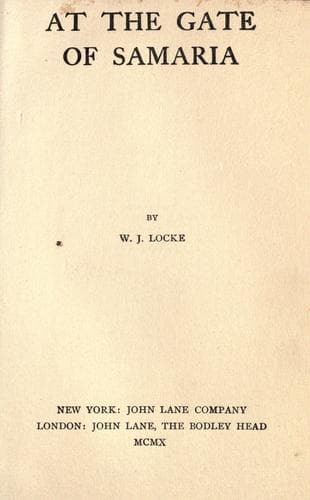
London (England) -- Fiction; Man-woman relationships -- Fiction; Women artists -- Fiction
“I don't think you understand me, Thornton. I will try to make it
clearer to you. As far as you will let me take an interest in your
life, I do so. I am more than willing to make any sacrifices--to give
up everything for you. But when you do not want me, as this autumn, I
surely may remember that I have a life of my own to lead.”
“And suppose that life does not suit me?”
“That is the point, Thornton. If you wished me, out of love for you, to
do anything, I would do it. But this is a matter in which love has no
place. Provided I am scrupulous in all my duties towards you, I have
a right to my own life, to my own antipathies, to my own favourite
pursuits--in fact to myself as an individual, and it is your duty
towards me to recognise it.”
“I don't quite see what you are driving at,” said Thornton. “You can
dislike sweet champagne and paint pictures and read Schopenhauer if you
like. Who is preventing you? But in certain matters, as you are my wife,
you have got to do what I tell you.”
“To take an extreme case, by way of argument: Suppose the fancy seized
you to order me to remain in my bedroom all day--you would expect me to
obey you?”
“By God! I should think I would!” cried Thornton, starting to his feet,
with blazing eyes and the veins standing out on his forehead.
“It seems, Thornton,” she said very quietly, “you have married the wrong
woman.”
Then she rose, too, from the table, moved towards him, and laid her hand
on his arm. He shook it off with an impatient oath, and turned away,
fuming, to stare out of the window. She was too well accustomed to his
fits of passion to resent the indignity. She mechanically picked off
some withering leaves from some flowers on the mantelpiece, and waited
for him to speak. At last he turned round again, and asked her sullenly:
“Have you any other pretty remarks to make?”
“If you will listen to them quietly.”
“Well, what do you want? I grant I was a fool to marry you. Let me hear
the consequences of my folly.”
His face was set in a sneer, an ugly expression. She had seen it several
times since that evening at the opera in Paris. The tears sprang into
her eyes as she glanced at him.
“Oh, don't speak and look like that!” she cried. “I cannot bear it. I
did not intend to say anything hard just now. I only meant that you
had mistaken me, and my needs, and my nature. I have tried to look upon
marriage from your point of view for four months, and I can't do it
any longer. You say I must obey you blindly in everything, even your
arbitrary fancies, subordinate myself absolutely to you. Thornton,
believe me, where your interests or love are concerned I will do it; but
where they are not I can't, and it will be happier for both of us that I
should tell you so frankly. If you go your way alone, I must go mine.”
“That means you set yourself in defiance to my wishes?”
Clytie checked an impulse of impatience.
“If you won't understand me, and insist on putting it that way--yes.”
Public-domain text, read in full here on John Shaqi.
Reviews
Reviews
No reviews yet
Be the first to share your thoughts on this work.
Elsewhere in the archive
Join the Discussion
Join the discussion
Sign in to leave a comment or review.
Sign InorCreate an account