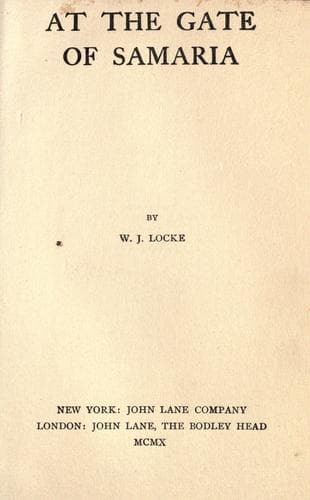
London (England) -- Fiction; Man-woman relationships -- Fiction; Women artists -- Fiction
But the individuals, when detached from the conglomerate mass of
humanity--what was this life to them? How far was it a gracious thing
to yonder bawling cheap-jack, with his red, sodden face? And the factory
girl, with her feathered hat and deep fringe overshadowing pinched,
soulless features, looking hungrily at his Brummagem wares; the fat,
unintelligent workman's wife gossiping loudly of sickness, death, and
funerals; the besotted navvy stumbling along in the grip of a soberer
friend--how far were they intellectually, spiritually, cognisant of
life? Again as of old these questions presented themselves to Clytie.
During these latter months she had been too closely confronted with the
problems of her own personality to interest herself in that of others.
But now a newly awakened self-knowledge had given her a key to mysteries
to the elucidation of which she had once devoted all her artistic
powers. She had arrived at the truth of the relativity of individual
life. There was no such thing as absolute fulness of existence.
Everyone--coster, factory girl, statesman, poet--was striving, each
in his way, after a completer life, but the ideal of completeness
was limited by each individual's capacity for action, sensation, and
thought. Hence yonder factory girl's life might be relatively as full
as her own, the hunger for the unknown that would complete it as loudly
clamourous. Clytie was glad for the moment, almost happy. New artistic
stirrings seemed to be at work within her soul. Heretofore she had
sought a solution for the problems of life through her art. Might not
this newer knowledge and more extensive sympathy enable her to present
finely perceived truths, thus making her art less self-centred, more
universal?
This train of thought was working through her mind as she sat by the
window, resting her cheek on her arm.
Gradually, however, the thoughts confused themselves into a medley of
dim associations, which in their turn became lost in drowsiness. Worn
out by the physical strain of the day, she fell asleep in the midst of
the uproar that arose from the hurrying street.
Suddenly she became conscious of a presence beside her in the room, and,
starting up, beheld Kent looking down upon her.
“You'll get cold or a stiff neck or something sleeping by the open
window like that,” he said in his kindly way. “And yet I did not like to
wake you.”
“I do feel a little cramped,” said Clytie, rising. “But the night is
hot. Bring another chair and sit down. I shall not go to sleep again.”
Kent did as she bade him, and they sat on either side of the window,
Clytie with face half averted looking into the street, Kent leaning
forward, gazing at her with troubled eyes. For some moments neither
spoke. At last Kent broke the silence.
“Clytie!”
“Yes?”
“Was I wrong to come in? Do you want to be alone? Tell me frankly and I
will go.”
Public-domain text, read in full here on John Shaqi.
Reviews
Reviews
No reviews yet
Be the first to share your thoughts on this work.
Elsewhere in the archive
Join the Discussion
Join the discussion
Sign in to leave a comment or review.
Sign InorCreate an account