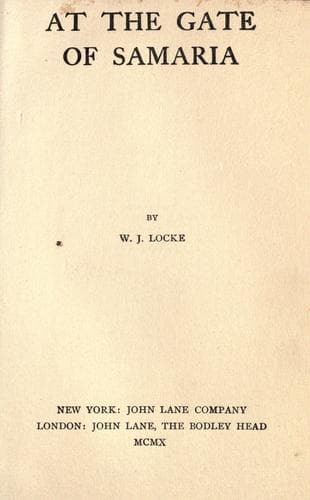
London (England) -- Fiction; Man-woman relationships -- Fiction; Women artists -- Fiction
But conditions were no longer the same. Clytie had renounced her married
life. Except as a memory of bitterness it had no place in her thoughts.
Except by a legal fiction she was her own mistress once more, free to
go and come, think and act. Even in name she would be Clytie Davenant
again, and she had spoken to him in that strange tone he had never heard
before, and had come nearer to him as her touch lay upon his arm. The
whole pent up passion of Kent's life had gone forth into that kiss. For
Kent the world was changed, and the night a dream of unutterable things.
But by the morning it had brought counsel. This love, acknowledged on
both sides--whither would it tend? A great problem. So great a one,
indeed, that Kent was tempted to shirk grappling with it. Courage and a
stout heart, he said to himself, and all would be well. But one cannot
rid one's self in this easy way of responsibilities. If you shake them
from your shoulders, they shackle themselves about your feet. Kent felt
thus fettered as he lay awake. Moreover, his early misgivings concerning
Hammerdyke came, like the curses in the proverb, home to roost. If he
had spoken to Clytie then, before her marriage, possibly she might have
been spared all this suffering. He wished that he had obtained from
Wither all the particulars of the ugly rumours that had been afloat,
investigated them, confronted Clytie bravely with the truth, and so
saved her from wrecking her life. And yet he felt that he could not
have done so. Well, what was past was past. The present and the future
contained enough matter to engage his attention. He lay for some time in
bed trying to solve these perplexities. At last, at half-past nine, he
rose, dressed, and went into his sitting-room to prepare his breakfast.
This was a simple process. On a couple of gas-stoves, connected by
india-rubber piping with the two gas-jets in his room, he placed a
kettle and a saucepan, the latter containing eggs. Then he spread a
little cloth on a clear space of his dresser-table, and brought out his
crockery and other breakfast requisites from one of the under-cupboards.
A ham somewhat cut into, butter, and marmalade he procured from a safe
in a third little room on the landing which he used as a combined larder
and lumber-room. For years Kent had enjoyed the simple Bohemianism of
this Sunday morning meal. He could linger over it easefully without the
weekday glance at his watch, when time was short. There was the Sunday
paper, a weekly review or two, the long, undisturbed after-breakfast
pipe. It was a time when he could release himself with free conscience
from his busy life and enjoy his leisure. But this morning the eggs
seemed stale, the ham tasteless, the journals dull, and he found himself
looking at his watch. He would go down and see Clytie at eleven, an hour
which he had himself arbitrarily fixed upon, and he was counting the
minutes. It is surprising how long minutes are when you count sixty of
them.
Public-domain text, read in full here on John Shaqi.
Reviews
Reviews
No reviews yet
Be the first to share your thoughts on this work.
Elsewhere in the archive
Join the Discussion
Join the discussion
Sign in to leave a comment or review.
Sign InorCreate an account