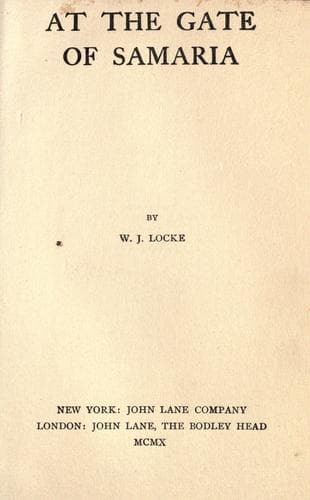
London (England) -- Fiction; Man-woman relationships -- Fiction; Women artists -- Fiction
They contained hours of sweet bitterness, it is true. Although Thornton
had gone out of her life like an evil phantom, yet the legal tie between
them remained unbroken. Mrs. Farquharson, who seldom did things by
halves, after seeing her idol broken trampled it underfoot into a
thousand pieces, and vehemently tried to persuade Clytie to seek after
a divorce. She even insisted upon her taking counsel's opinion on the
matter. But there was no definite evidence obtainable to support an
action at law, and Clytie, sick at heart, was glad to dismiss the
question from her mind forever. Yet in the eyes of the world she was
Hammerdyke's wife, and so she would have to remain until death
parted them. Perhaps when enlightenment sheds a fuller ray upon our
civilisation we shall make radical changes in our marriage laws, for
they are based upon the sad old fallacy that human conduct and human
emotion are indifferently susceptible of regulation. As yet we can
universalise only on material things: security of property, full
stomachs, and warm backs for the poor. The facts of broken lives and
torn hearts we can recognise only in particular instances, as they come
within each man's individual sphere. The universality of spiritual,
moral, and emotional suffering is as yet far from being a national
conception. When this is attained we may hope for social conditions
happier than those under which we struggle at present.
Thornton had taken the most effectual steps to become an undisturbing
element in Clytie's life. The constituency for which he had intrigued
and striven to be nominated did not return him at the bye-election,
which took place soon after Clytie's departure, but chose instead a
radical lawyer with an insignificant presence and a shakiness as to
aspirates. Thornton was disgusted and humiliated at his defeat. Politics
lost their charm. An offer from the Belgian government to reform the
administration in a wide tract of country whose borders were infested
with Arabs came to him at this juncture, and found him in a mood for
acceptance. He bade Mrs. Clavering a sardonic farewell and replunged
into the wilds out of English ken.
Winifred only remained in the King's Road for a few months. Early in
the new year she married Treherne, and Clytie was left alone. The studio
seemed very forlorn for some time afterwards, robbed, as it were, of an
inherent tender grace, a softening, refining influence that had always
been dear to Clytie, even in her days of greatest wilfulness. Yet it
gladdened her to know that Winifred was happy--married to a man of fine
fibre who could value the exquisite gift that the high gods had given
him.
“You are a lucky girl, dear,” she said to the young bride one day when
visiting her in her new home.
“Of course I am,” replied Winifred enthusiastically. “A man like
Victor----”
Public-domain text, read in full here on John Shaqi.
Reviews
Reviews
No reviews yet
Be the first to share your thoughts on this work.
Elsewhere in the archive
Join the Discussion
Join the discussion
Sign in to leave a comment or review.
Sign InorCreate an account