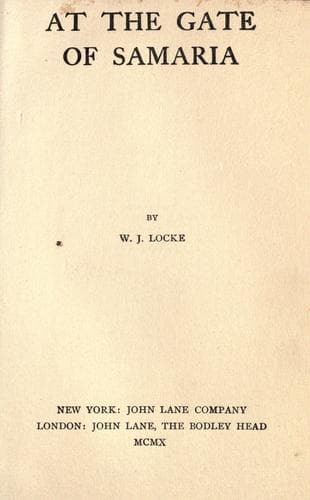
London (England) -- Fiction; Man-woman relationships -- Fiction; Women artists -- Fiction
He tossed down his pencil in disgust and swung round towards the fire.
It was Clytie herself, then, that he missed. He missed her in spite of
her being a woman, he told himself. And yet the picture rose before his
mind of Clytie's dainty room and Clytie sitting there opposite to him,
her hand, with falling lace at wrist, pressed into the softness of her
hair. Why had she not written a line to him?
Yes, he missed her. But why should that make his work distasteful?
He was puzzled. One thing alone was clear, his loneliness was growing
intolerable. He threw on his waterproof, and, leaving his work, trudged
through the rain to the “monastery,” at South Kensington.
Wither was alone. Fairfax and Greene were dining out. The little man
had been too lazy and sybaritic to face the cold and wet outside. He
had clad himself in pyjamas and dressing-gown, and was reading a French
novel on the couch drawn up in front of the fire. His diminutive
figure looked absurdly small and wizened in his loose wrap. He nodded
affectionately at Kent, explained briefly the fact of his being alone,
and, while Kent was hunting in a familiar corner for the pair of
slippers always there in readiness for his use, went on with his
reading.
“Get me some whiskey, old chap,” he said without looking up. “I have
been dying for some this last hour and I have been too lazy to stir off
the sofa.”
Kent, as usual, supplied Wither's wants and poured out a glass for
himself.
“Lazy little beggar,” he said kindly as he sat down in the great
saddle-bag chair. “How do you manage to get through your work?”
Wither laughed.
“I thought you knew better than to ask me that.”
It was a tradition in the “monastery” that Wither never did any work.
They paid him at his office for lending it a gentlemanly tone. As a
matter of fact, like most clever, lazy men, he generally did an ordinary
man's day's work in a few hours.
He stretched himself out luxuriously and lit a cigarette.
“Have you ever read this?” he asked, holding up his novel. It was
Bourget's “Cruelle Enigme.”
Kent nodded.
“I skimmed it through here one night while waiting for you. I have no
patience with that sort of thing.”
“Possibly not,” remarked Wither, “but that's a fact about yourself, and
not about the book.”
“I don't believe it is human life,” replied Kent. “People can't make
animal passion the keynote of their lives nowadays.”
“Why not nowadays?”
“The conditions of life prevent it. The savage has furious brute
instincts, which he gratifies occasionally, when his mind is not
taken up with fighting and hunting for his food. It may be the guiding
principle in a splendid barbarism like some Eastern courts, where men
have little else to think of. But in our modern civilisation there are
other interests too absorbing. The hurry of life is too great.”
“What about the empty-minded women you are always railing at?”
Public-domain text, read in full here on John Shaqi.
Reviews
Reviews
No reviews yet
Be the first to share your thoughts on this work.
Elsewhere in the archive
Join the Discussion
Join the discussion
Sign in to leave a comment or review.
Sign InorCreate an account