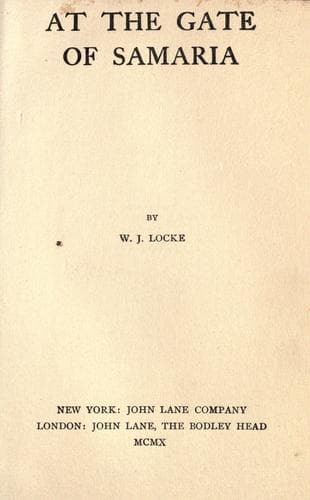
London (England) -- Fiction; Man-woman relationships -- Fiction; Women artists -- Fiction
“So you are keeping up a violent correspondence with that man,” she
remarked acidly to Clytie. It is the way of some women to exaggerate.
Clytie bit her lip, cheeking an impulsive answer. What was the use of a
retort?
Women of broad, liberal education, with interests beyond the nursery,
still-room, and the afternoon-tea table, are known to live together,
like men, in comparative harmony. They have learned the lesson the
higher, broader life teaches of rising or declining instinctively to
another being's plane of thought or feeling. It is hardly a fault of sex
that women are petty, spiteful, and intolerant. When the conditions of
life are narrow and illiberal any human being, man or woman, runs the
risk of being shaped by them. And that is why Mrs. Blather and Janet,
good, upright women according to their lights, subordinated their
affection to their principles, and stood away shocked from their sister.
Their traditional ideals of femininity had been sinned against. The
crime was all but unpardonable. It was always present with them, always
assuming fresh, distorted shapes. They were on a different plane from
Clytie, and viewed all her actions in a false perspective.
Clytie was hurt, wounded in her womanly pride. She knew that there
was much clay in her composition, and often felt with chastening
self-abasement how much nearer the angels Winifred was than herself.
Yet she was accustomed to live in an atmosphere free from reproach.
Winifred, Kent, the Farquharsons, and others of her friends might touch
with light, tender finger on here and there an imperfection in her
character or conduct; for this she was grateful, knowing the deeper
feelings of esteem and respect that prompted. But to move in a circle
where she was looked upon as a black sheep, as a girl on the path
to unutterable abysses, galled her to the quick, sent the hot blood
mounting in stinging waves to her cheek, leaving the heart cold. Yet
she had learned not to blame her sisters over much. She had lost her
militant scorn of Jacob. Kent had taught her that although Esau might
possess the higher birthright which no bartering of pottage could
alienate, there was still saving grace in the stolen birthright which
Jacob guarded so jealously. But this knowledge did not make her heart
less sore.
Public-domain text, read in full here on John Shaqi.
Reviews
Reviews
No reviews yet
Be the first to share your thoughts on this work.
Elsewhere in the archive
Join the Discussion
Join the discussion
Sign in to leave a comment or review.
Sign InorCreate an account