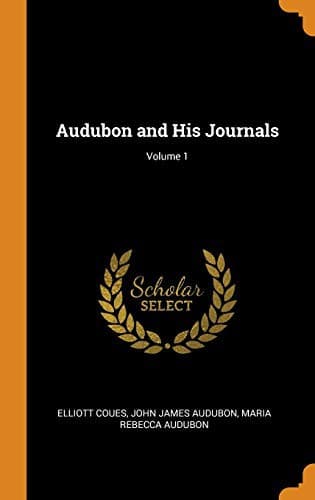
Audubon and His Journals, Volume 1Audubon, John James
History
Audubon and His Journals, Volume 1
Audubon, John James
Audubon, John James, 1785-1851 -- Diaries; Birds -- North America; Naturalists -- United States -- Diaries
Eastport standing in the bow of his vessel; he bid us welcome, and we
saw the codfish thrown on his deck by thousands. We were now opposite
to the mouth of the Natasquan River, where the Hudson's Bay Company
have a fishing establishment, but where no American vessels are
allowed to come in. The shore was lined with bark-covered huts, and
some vessels were within the bight, or long point of land which pushes
out from the extreme eastern side of the entrance of the river. We
went on to an American Harbor, four or five miles distant to the
westward, and after a while came to anchor in a small bay, perfectly
secure from any winds. And now we are positively on the Labrador
coast, latitude 50 deg. and a little more,--farther north than I ever was
before. But what a country! When we landed and passed the beach, we
sank nearly up to our knees in mosses of various sorts, producing as
we moved through them a curious sensation. These mosses, which at a
distance look like hard rocks, are, under foot, like a velvet cushion.
We scrambled about, and with anxiety stretched our necks and looked
over the country far and near, but not a square foot of _earth_ could
we see. A poor, rugged, miserable country; the trees like so many mops
of wiry composition, and where the soil is not rocky it is boggy up to
a man's waist. We searched and searched; but, after all, only shot an
adult Pigeon-Hawk, a summer-plumage Tell-tale Godwit, and an _Alca
torda_. We visited all the islands about the harbor; they were all
rocky, nothing but rocks. The _Larus marinus_ was sailing magnificently
all about us. The Great Tern was plunging after shrimps in every pool,
and we found four eggs of the _Totanus macularius_;[180] the nest was
situated under a rock in the grass, and made of a quantity of dried
grass, forming a very decided nest, at least much more so than in our
Middle States, where the species breed so very abundantly. Wild Geese
were seen by our party, and these birds also breed here; we saw Loons
and Eider Ducks, _Anas obscura_[181] and the _Fuligula [[OE]demia]
americana_.[182] We came to our anchorage at twenty minutes past
twelve. Tom Lincoln and John heard a Ptarmigan. Toads were abundant.
We saw some rare plants, which we preserved, and butterflies and small
bees were among the flowers which we gathered. We also saw
Red-breasted Mergansers. The male and female Eider Ducks separate as
soon as the latter begin to lay; after this they are seen flying in
large flocks, each sex separately. We found a dead Basking Shark, six
and a half feet long; this fish had been wounded by a harpoon and ran
ashore, or was washed there by the waves. At Eastport fish of this
kind have been killed thirty feet long.
Public-domain text, read in full here on John Shaqi.
Reviews
Reviews
No reviews yet
Be the first to share your thoughts on this work.
Elsewhere in the archive
Join the Discussion
Join the discussion
Sign in to leave a comment or review.
Sign InorCreate an account