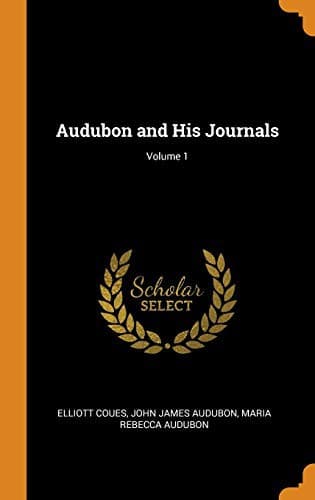
Audubon and His Journals, Volume 1Audubon, John James
History
Audubon and His Journals, Volume 1
Audubon, John James
Audubon, John James, 1785-1851 -- Diaries; Birds -- North America; Naturalists -- United States -- Diaries
these birds on the islands of Partridge Bay, about forty miles west of
this place, that a boat load of their eggs might have been collected
if they had been fresh; they are then excellent eating. Our captain
called on a half-breed Indian in the employ of the Northeast Fur and
Fish Co., living with his squaw and two daughters. A potato patch of
about an acre was planted in _sand_, for not a foot of _soil_ is there
to be found hereabouts. The man told him his potatoes grew well and
were good, ripening in a few weeks, which he called the summer. The
mosquitoes and black gnats are bad enough on shore. I heard a Wood
Pewee. The Wild Goose is an excellent diver, and when with its young
uses many beautiful stratagems to save its brood, and elude the
hunter. They will dive and lead their young under the surface of the
water, and always in a contrary direction to the one expected; thus if
you row a boat after one it will dive under it, and now and then
remain under it several minutes, when the hunter with outstretched
neck, is looking, all in vain, in the distance for the _stupid Goose_!
Every time I read or hear of a stupid animal in a wild state, I cannot
help wishing that the stupid animal who speaks thus, was half as wise
as the brute he despises, so that he might be able to thank his Maker
for what knowledge he may possess. I found many small flowers open
this day, where none appeared last evening. All vegetable life here is
of the pygmy order, and so ephemeral that it shoots out of the tangled
mass of ages, blooms, fructifies, and dies, in a few weeks. We
ascertained to-day that a party of four men from Halifax took last
spring nearly forty thousand eggs, which they sold at Halifax and
other towns at twenty-five cents per dozen, making over $800; this was
done in about two months. Last year upwards of twenty sail were
engaged in "egging;" so some idea may be formed of the birds that are
destroyed in this rascally way. The eggers destroy all the eggs that
are sat upon, to force the birds to lay again, and by robbing them
regularly, they lay till nature is exhausted, and few young are
raised. In less than half a century these wonderful nurseries will be
entirely destroyed, unless some kind government will interfere to stop
the shameful destruction.
Public-domain text, read in full here on John Shaqi.
Reviews
Reviews
No reviews yet
Be the first to share your thoughts on this work.
Elsewhere in the archive
Join the Discussion
Join the discussion
Sign in to leave a comment or review.
Sign InorCreate an account