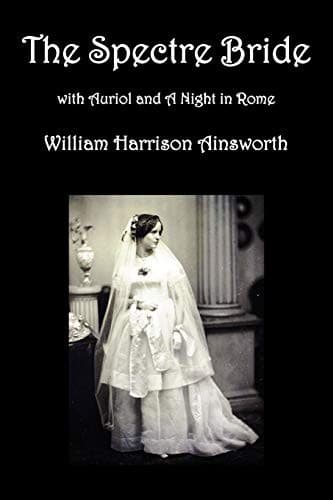
Auriol; or, The Elixir of LifeAinsworth, William Harrison
Science
Auriol; or, The Elixir of Life
Ainsworth, William Harrison
Detective and mystery stories; Gothic fiction; Horror tales; Paranormal fiction
While gazing upon this group, I chanced upon an individual whom I had
not hitherto noticed, and who now irresistibly attracted my attention.
Though a little removed from the Calabrian mountaineers, and reclining
against the marble walls of the church, he evidently belonged to the
same company; at least, so his attire seemed to indicate, though the
noble cast of his countenance was far superior to that of his comrades.
He was an old man, with a face of the fine antique Roman stamp--a bold
outline of prominent nose, rugged and imperious brow, and proudly-cut
chin. His head and chin, as well as his naked breast, were frosted over
with the snowy honours of many winters, and their hoar appearance
contrasted strikingly with the tawny hue of a skin almost as dark and as
lustrous as polished oak. Peasant as he was, there was something of
grandeur and majesty in this old man's demeanour and physiognomy. His
head declined backwards, so as completely to expose his long and
muscular throat. His arms hung listlessly by his side; one hand drooped
upon the pavement, the other was placed within his breast: his eyes were
closed. The old man's garb was of the coarsest fabric; he wore little
beyond a shirt, a loose vest, a sort of sheep-skin cloak, and canvas
leggings bound around with leathern thongs. His appearance, however, was
above his condition; he became his rags as proudly as a prince would
have become his ermined robe.
The more I scrutinised the rigid lines of this old man's countenance,
the more I became satisfied that many singular, and perhaps not wholly
guiltless, events were connected with his history. The rosary was in his
hand--the cross upon his breast--the beads were untold--the crucifix
unclasped--no breath of prayer passed his lips. His face was turned
heavenward, but his eyes were closed,--he dared not open them. Why did
he come thither, if he did not venture to pray? Why did he assume a
penitential attitude, if he felt no penitence?
So absorbed was I in the perusal of the workings of this old man's
countenance, as to be scarcely conscious that the service of high mass
was concluded, and the crowd within the holy pile fast dispersing. The
music was hushed, the robed prelates and their train had disappeared,
joyous dames were hastening along the marble aisles to their equipages;
all, save a few kneeling figures near the chapels, were departing; and
the old man, aware, from the stir and hum prevailing around, that the
ceremonial was at an end, arose, stretched out his arm to one of his
comrades, a youth who had joined him, and prepared to follow the
concourse.
Was he really blind? Assuredly not. Besides, he did not walk like as one
habituated to the direst calamity that can befall our nature. He
staggered in his gait, and reeled to and fro. Yet wherefore did he not
venture to unclose his eyes within the temple of the Most High? What
would I not have given to be made acquainted with his history! For I
felt that it must be a singular one.
Public-domain text, read in full here on John Shaqi.
Reviews
Reviews
No reviews yet
Be the first to share your thoughts on this work.
Elsewhere in the archive
Join the Discussion
Join the discussion
Sign in to leave a comment or review.
Sign InorCreate an account