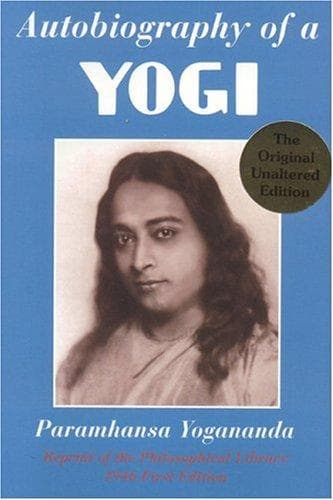
Yogananda, Paramahansa, 1893-1952; Yogis -- India -- Biography
All thoughts vibrate eternally in the cosmos. By deep concentration, a
master is able to detect the thoughts of any mind, living or dead.
Thoughts are universally and not individually rooted; a truth
cannot be created, but only perceived. The erroneous thoughts of
man result from imperfections in his discernment. The goal of yoga
science is to calm the mind, that without distortion it may mirror
the divine vision in the universe.
Radio and television have brought the instantaneous sound and sight
of remote persons to the firesides of millions: the first faint
scientific intimations that man is an all-pervading spirit. Not
a body confined to a point in space, but the vast soul, which the
ego in most barbaric modes conspires in vain to cramp.
“Very strange, very wonderful, seemingly very improbable phenomena
may yet appear which, when once established, will not astonish us
more than we are now astonished at all that science has taught us
during the last century,” Charles Robert Richet, Nobel Prizeman in
physiology, has declared. “It is assumed that the phenomena which
we now accept without surprise, do not excite our astonishment
because they are understood. But this is not the case. If they do
not surprise us it is not because they are understood, it is because
they are familiar; for if that which is not understood ought to
surprise us, we should be surprised at everything-the fall of a
stone thrown into the air, the acorn which becomes an oak, mercury
which expands when it is heated, iron attracted by a magnet,
phosphorus which burns when it is rubbed. . . . The science of
today is a light matter; the revolutions and evolutions which it
will experience in a hundred thousand years will far exceed the
most daring anticipations. The truths-those surprising, amazing,
unforeseen truths-which our descendants will discover, are even
now all around us, staring us in the eyes, so to speak, and yet
we do not see them. But it is not enough to say that we do not see
them; we do not wish to see them; for as soon as an unexpected and
unfamiliar fact appears, we try to fit it into the framework of
the commonplaces of acquired knowledge, and we are indignant that
anyone should dare to experiment further.”
A humorous occurrence took place a few days after I had been so
implausibly robbed of a cauliflower. A certain kerosene lamp could
not be found. Having so lately witnessed my guru’s omniscient
insight, I thought he would demonstrate that it was child’s play
to locate the lamp.
Master perceived my expectation. With exaggerated gravity he
questioned all ashram residents. A young disciple confessed that
he had used the lamp to go to the well in the back yard.
Sri Yukteswar gave the solemn counsel: “Seek the lamp near the
well.”
I rushed there; no lamp! Crestfallen, I returned to my guru. He
was now laughing heartily, without compunction for my disillusionment.
Public-domain text, read in full here on John Shaqi.
Reviews
Reviews
No reviews yet
Be the first to share your thoughts on this work.
Elsewhere in the archive
Join the Discussion
Join the discussion
Sign in to leave a comment or review.
Sign InorCreate an account