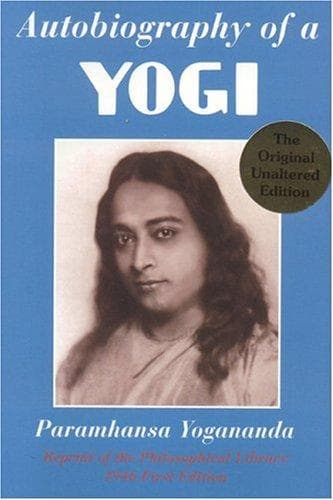
Yogananda, Paramahansa, 1893-1952; Yogis -- India -- Biography
Many guests went upstairs to receive a pudding of CHANNA and
oranges. I made my way to a group of brother disciples who were
serving today as cooks. Food for such large gatherings had to
be cooked outdoors in huge cauldrons. The improvised wood-burning
brick stoves were smoky and tear-provoking, but we laughed merrily
at our work. Religious festivals in India are never considered
troublesome; each one does his part, supplying money, rice,
vegetables, or his personal services.
Master was soon in our midst, supervising the details of the feast.
Busy every moment, he kept pace with the most energetic young
student.
A SANKIRTAN (group chanting), accompanied by the harmonium and
hand-played Indian drums, was in progress on the second floor. Sri
Yukteswar listened appreciatively; his musical sense was acutely
perfect.
“They are off key!” Master left the cooks and joined the artists.
The melody was heard again, this time correctly rendered.
In India, music as well as painting and the drama is considered a
divine art. Brahma, Vishnu, and Shiva-the Eternal Trinity-were the
first musicians. The Divine Dancer Shiva is scripturally represented
as having worked out the infinite modes of rhythm in His cosmic
dance of universal creation, preservation, and dissolution, while
Brahma accentuated the time-beat with the clanging cymbals, and
Vishnu sounded the holy MRIDANGA or drum. Krishna, an incarnation
of Vishnu, is always shown in Hindu art with a flute, on which
he plays the enrapturing song that recalls to their true home the
human souls wandering in MAYA-delusion. Saraswati, goddess of wisdom,
is symbolized as performing on the VINA, mother of all stringed
instruments. The SAMA VEDA of India contains the world’s earliest
writings on musical science.
The foundation stone of Hindu music is the RAGAS or fixed melodic
scales. The six basic RAGAS branch out into 126 derivative RAGINIS
(wives) and PUTRAS (sons). Each RAGA has a minimum of five notes:
a leading note (VADI or king), a secondary note (SAMAVADI or prime
minister), helping notes (ANUVADI, attendants), and a dissonant
note (VIVADI, the enemy).
Each one of the six basic RAGAS has a natural correspondence with
a certain hour of the day, season of the year, and a presiding
deity who bestows a particular potency. Thus, (1) the HINDOLE RAGA
is heard only at dawn in the spring, to evoke the mood of universal
love; (2) DEEPAKA RAGA is played during the evening in summer, to
arouse compassion; (3) MEGHA RAGA is a melody for midday in the
rainy season, to summon courage; (4) BHAIRAVA RAGA is played in the
mornings of August, September, October, to achieve tranquillity;
(5) SRI RAGA is reserved for autumn twilights, to attain pure love;
(6) MALKOUNSA RAGA is heard at midnights in winter, for valor.
Public-domain text, read in full here on John Shaqi.
Reviews
Reviews
No reviews yet
Be the first to share your thoughts on this work.
Elsewhere in the archive
Join the Discussion
Join the discussion
Sign in to leave a comment or review.
Sign InorCreate an account