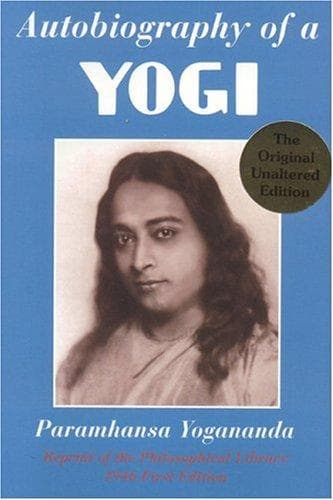
Yogananda, Paramahansa, 1893-1952; Yogis -- India -- Biography
One thousand KRIYA practiced in eight hours gives the yogi, in one
day, the equivalent of one thousand years of natural evolution:
365,000 years of evolution in one year. In three years, a KRIYA
YOGI can thus accomplish by intelligent self-effort the same result
which nature brings to pass in a million years. The KRIYA short
cut, of course, can be taken only by deeply developed yogis. With
the guidance of a guru, such yogis have carefully prepared their
bodies and brains to receive the power created by intensive practice.
The KRIYA beginner employs his yogic exercise only fourteen to
twenty-eight times, twice daily. A number of yogis achieve emancipation
in six or twelve or twenty-four or forty-eight years. A yogi who
dies before achieving full realization carries with him the good
karma of his past KRIYA effort; in his new life he is harmoniously
propelled toward his Infinite Goal.
The body of the average man is like a fifty-watt lamp, which cannot
accommodate the billion watts of power roused by an excessive practice
of KRIYA. Through gradual and regular increase of the simple and
“foolproof” methods of KRIYA, man’s body becomes astrally transformed
day by day, and is finally fitted to express the infinite potentials
of cosmic energy-the first materially active expression of Spirit.
KRIYA YOGA has nothing in common with the unscientific breathing
exercises taught by a number of misguided zealots. Their attempts
to forcibly hold breath in the lungs is not only unnatural but
decidedly unpleasant. KRIYA, on the other hand, is accompanied
from the very beginning by an accession of peace, and by soothing
sensations of regenerative effect in the spine.
The ancient yogic technique converts the breath into mind. By
spiritual advancement, one is able to cognize the breath as an act
of mind-a dream-breath.
Many illustrations could be given of the mathematical relationship
between man’s respiratory rate and the variations in his states of
consciousness. A person whose attention is wholly engrossed, as in
following some closely knit intellectual argument, or in attempting
some delicate or difficult physical feat, automatically breathes
very slowly. Fixity of attention depends on slow breathing; quick
or uneven breaths are an inevitable accompaniment of harmful
emotional states: fear, lust, anger. The restless monkey breathes
at the rate of 32 times a minute, in contrast to man’s average of
18 times. The elephant, tortoise, snake and other animals noted for
their longevity have a respiratory rate which is less than man’s.
The tortoise, for instance, who may attain the age of 300 years,
{FN26-12} breathes only 4 times per minute.
Public-domain text, read in full here on John Shaqi.
Reviews
Reviews
No reviews yet
Be the first to share your thoughts on this work.
Elsewhere in the archive
Join the Discussion
Join the discussion
Sign in to leave a comment or review.
Sign InorCreate an account