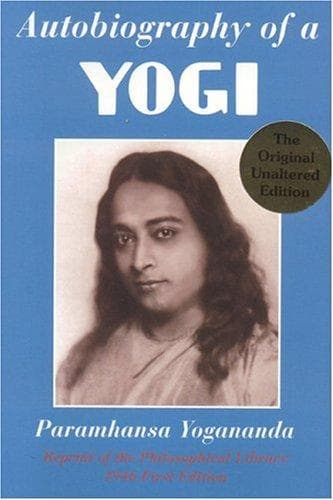
Yogananda, Paramahansa, 1893-1952; Yogis -- India -- Biography
Sri Yukteswar was expounding the Christian scriptures one sunny
morning on the balcony of his Serampore hermitage. Besides a few
of Master’s other disciples, I was present with a small group of
my Ranchi students.
“In this passage Jesus calls himself the Son of God. Though he was
truly united with God, his reference here has a deep impersonal
significance,” my guru explained. “The Son of God is the Christ or
Divine Consciousness in man. No MORTAL can glorify God. The only
honor that man can pay his Creator is to seek Him; man cannot glorify
an Abstraction that he does not know. The ‘glory’ or nimbus around
the head of the saints is a symbolic witness of their CAPACITY to
render divine homage.”
Sri Yukteswar went on to read the marvelous story of Lazarus’
resurrection. At its conclusion Master fell into a long silence,
the sacred book open on his knee.
“I too was privileged to behold a similar miracle.” My guru finally
spoke with solemn unction. “Lahiri Mahasaya resurrected one of my
friends from the dead.”
The young lads at my side smiled with keen interest. There was
enough of the boy in me, too, to enjoy not only the philosophy
but, in particular, any story I could get Sri Yukteswar to relate
about his wondrous experiences with his guru.
“My friend Rama and I were inseparable,” Master began. “Because he
was shy and reclusive, he chose to visit our guru Lahiri Mahasaya
only during the hours of midnight and dawn, when the crowd of
daytime disciples was absent. As Rama’s closest friend, I served as
a spiritual vent through which he let out the wealth of his spiritual
perceptions. I found inspiration in his ideal companionship.” My
guru’s face softened with memories.
“Rama was suddenly put to a severe test,” Sri Yukteswar continued.
“He contracted the disease of Asiatic cholera. As our master never
objected to the services of physicians at times of serious illness,
two specialists were summoned. Amidst the frantic rush of ministering
to the stricken man, I was deeply praying to Lahiri Mahasaya for
help. I hurried to his home and sobbed out the story.
“‘The doctors are seeing Rama. He will be well.’ My guru smiled
jovially.
“I returned with a light heart to my friend’s bedside, only to find
him in a dying state.
“‘He cannot last more than one or two hours,’ one of the physicians
told me with a gesture of despair. Once more I hastened to Lahiri
Mahasaya.
“‘The doctors are conscientious men. I am sure Rama will be well.’
The master dismissed me blithely.
“At Rama’s place I found both doctors gone. One had left me a note:
‘We have done our best, but his case is hopeless.’
“My friend was indeed the picture of a dying man. I did not understand
how Lahiri Mahasaya’s words could fail to come true, yet the sight
of Rama’s rapidly ebbing life kept suggesting to my mind: ‘All is
over now.’ Tossing thus on the seas of faith and apprehensive doubt,
I ministered to my friend as best I could. He roused himself to
cry out:
Public-domain text, read in full here on John Shaqi.
Reviews
Reviews
No reviews yet
Be the first to share your thoughts on this work.
Elsewhere in the archive
Join the Discussion
Join the discussion
Sign in to leave a comment or review.
Sign InorCreate an account