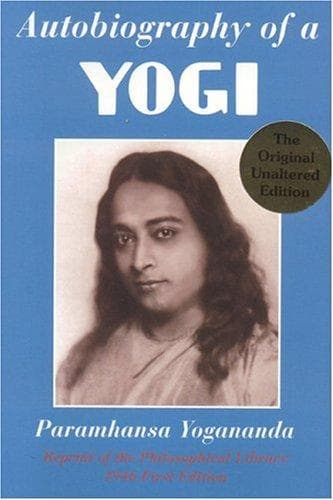
Yogananda, Paramahansa, 1893-1952; Yogis -- India -- Biography
As I was taking leave of the gentle sage, he autographed a small volume
and presented it to me. {FN38-1} “Here is my book on THE TRAINING
OF THE HUMAN PLANT,” {FN38-2} he said. “New types of training are
needed-fearless experiments. At times the most daring trials have
succeeded in bringing out the best in fruits and flowers. Educational
innovations for children should likewise become more numerous, more
courageous.”
I read his little book that night with intense interest. His eye
envisioning a glorious future for the race, he wrote: “The most
stubborn living thing in this world, the most difficult to swerve,
is a plant once fixed in certain habits. . . . Remember that this
plant has preserved its individuality all through the ages; perhaps
it is one which can be traced backward through eons of time in the
very rocks themselves, never having varied to any great extent in
all these vast periods. Do you suppose, after all these ages of
repetition, the plant does not become possessed of a will, if you
so choose to call it, of unparalleled tenacity? Indeed, there are
plants, like certain of the palms, so persistent that no human
power has yet been able to change them. The human will is a weak
thing beside the will of a plant. But see how this whole plant’s
lifelong stubbornness is broken simply by blending a new life with
it, making, by crossing, a complete and powerful change in its life.
Then when the break comes, fix it by these generations of patient
supervision and selection, and the new plant sets out upon its new
way never again to return to the old, its tenacious will broken
and changed at last.
“When it comes to so sensitive and pliable a thing as the nature
of a child, the problem becomes vastly easier.”
Magnetically drawn to this great American, I visited him again and
again. One morning I arrived at the same time as the postman, who
deposited in Burbank’s study about a thousand letters. Horticulturists
wrote him from all parts of the world.
“Swamiji, your presence is just the excuse I need to get out into
the garden,” Luther said gaily. He opened a large desk-drawer
containing hundreds of travel folders.
“See,” he said, “this is how I do my traveling. Tied down by my
plants and correspondence, I satisfy my desire for foreign lands
by a glance now and then at these pictures.”
My car was standing before his gate; Luther and I drove along the
streets of the little town, its gardens bright with his own varieties
of Santa Rosa, Peachblow, and Burbank roses.
“My friend Henry Ford and I both believe in the ancient theory of
reincarnation,” Luther told me. “It sheds light on aspects of life
otherwise inexplicable. Memory is not a test of truth; just because
man fails to remember his past lives does not prove he never had
them. Memory is blank concerning his womb-life and infancy, too;
but he probably passed through them!” He chuckled.
Public-domain text, read in full here on John Shaqi.
Reviews
Reviews
No reviews yet
Be the first to share your thoughts on this work.
Elsewhere in the archive
Join the Discussion
Join the discussion
Sign in to leave a comment or review.
Sign InorCreate an account