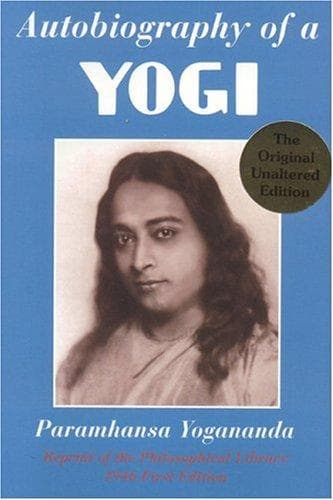
Yogananda, Paramahansa, 1893-1952; Yogis -- India -- Biography
In this chapter of my autobiography I have obeyed my guru’s behest
and spread the glad tiding, though it confound once more an incurious
generation. Groveling, man knows well; despair is seldom alien;
yet these are perversities, no part of man’s true lot. The day he
wills, he is set on the path to freedom. Too long has he hearkened
to the dank pessimism of his “dust-thou-art” counselors, heedless
of the unconquerable soul.
I was not the only one privileged to behold the Resurrected Guru.
One of Sri Yukteswar’s chelas was an aged woman, affectionately
known as MA (Mother), whose home was close to the Puri hermitage.
Master had often stopped to chat with her during his morning walk.
On the evening of March 16, 1936, Ma arrived at the ashram and
asked to see her guru.
“Why, Master died a week ago!” Swami Sebananda, now in charge of
the Puri hermitage, looked at her sadly.
“That’s impossible!” She smiled a little. “Perhaps you are just
trying to protect the guru from insistent visitors?”
“No.” Sebananda recounted details of the burial. “Come,” he said,
“I will take you to the front garden to Sri Yukteswarji’s grave.”
Ma shook her head. “There is no grave for him! This morning at ten
o’clock he passed in his usual walk before my door! I talked to
him for several minutes in the bright outdoors.
“‘Come this evening to the ashram,’ he said.
“I am here! Blessings pour on this old gray head! The deathless guru
wanted me to understand in what transcendent body he had visited
me this morning!”
The astounded Sebananda knelt before her.
“Ma,” he said, “what a weight of grief you lift from my heart! He
is risen!”
{FN43-1} In SABIKALPA SAMADHI the devotee has spiritually progressed
to a state of inward divine union, but cannot maintain his cosmic
consciousness except in the immobile trance-state. By continuous
meditation, he reaches the superior state of NIRBIKALPA SAMADHI,
where he moves freely in the world and performs his outward duties
without any loss of God-realization.
{FN43-2} Sri Yukteswar used the word PRANA; I have translated it as
lifetrons. The Hindu scriptures refer not only to the ANU, “atom,”
and to the PARAMANU, “beyond the atom,” finer electronic energies;
but also to PRANA, “creative lifetronic force.” Atoms and electrons
are blind forces; PRANA is inherently intelligent. The pranic
lifetrons in the spermatozoa and ova, for instance, guide the
embryonic development according to a karmic design.
{FN43-3} Adjective of MANTRA, chanted seed-sounds discharged by
the mental gun of concentration. The PURANAS (ancient SHASTRAS or
treatises) describe these MANTRIC wars between DEVAS and ASURAS
(gods and demons). An ASURA once tried to slay a DEVA with a potent
chant. But due to mispronunciation the mental bomb acted as a
boomerang and killed the demon.
{FN43-4} Examples of such powers are not wanting even on earth, as
in the case of Helen Keller and other rare beings.
Public-domain text, read in full here on John Shaqi.
Reviews
Reviews
No reviews yet
Be the first to share your thoughts on this work.
Elsewhere in the archive
Join the Discussion
Join the discussion
Sign in to leave a comment or review.
Sign InorCreate an account