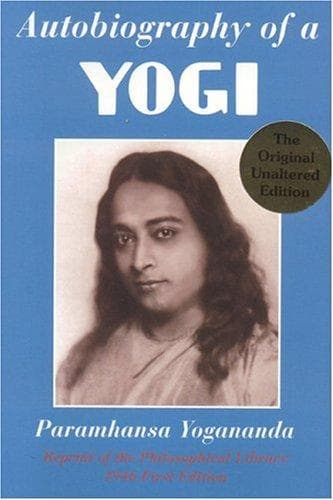
Yogananda, Paramahansa, 1893-1952; Yogis -- India -- Biography
In an article in EAST-WEST, April, 1934, a summary of VAISESIKA
scientific knowledge was given as follows: “Though the modern
‘atomic theory’ is generally considered a new advance of science,
it was brilliantly expounded long ago by Kanada, ‘the atom-eater.’
The Sanskrit ANUS can be properly translated as ‘atom’ in the latter’s
literal Greek sense of ‘uncut’ or indivisible. Other scientific
expositions of VAISESIKA treatises of the B.C. era include (1) the
movement of needles toward magnets, (2) the circulation of water
in plants, (3) AKASH or ether, inert and structureless, as a basis
for transmitting subtle forces, (4) the solar fire as the cause of
all other forms of heat, (5) heat as the cause of molecular change,
(6) the law of gravitation as caused by the quality that inheres in
earth-atoms to give them their attractive power or downward pull,
(7) the kinetic nature of all energy; causation as always rooted
in an expenditure of energy or a redistribution of motion, (8)
universal dissolution through the disintegration of atoms, (9)
the radiation of heat and light rays, infinitely small particles,
darting forth in all directions with inconceivable speed (the modern
‘cosmic rays’ theory), (10) the relativity of time and space.
“VAISESIKA assigned the origin of the world to atoms, eternal in
their nature, i.e., their ultimate peculiarities. These atoms were
regarded as possessing an incessant vibratory motion. . . . The
recent discovery that an atom is a miniature solar system would be
no news to the old VAISESIKA philosophers, who also reduced time to
its furthest mathematical concept by describing the smallest unit
of time (KALA) as the period taken by an atom to traverse its own
unit of space.”
{FN8-6} Translated from the Bengali of Rabindranath Tagore, by
Manmohan Ghosh, in VISWA-BHARATI.
CHAPTER: 9
THE BLISSFUL DEVOTEE AND HIS COSMIC ROMANCE
“Little sir, please be seated. I am talking to my Divine Mother.”
Silently I had entered the room in great awe. The angelic
appearance of Master Mahasaya fairly dazzled me. With silky white
beard and large lustrous eyes, he seemed an incarnation of purity.
His upraised chin and folded hands apprized me that my first visit
had disturbed him in the midst of his devotions.
His simple words of greeting produced the most violent effect my
nature had so far experienced. The bitter separation of my mother’s
death I had thought the measure of all anguish. Now an agony at
separation from my Divine Mother was an indescribable torture of
the spirit. I fell moaning to the floor.
“Little sir, quiet yourself!” The saint was sympathetically
distressed.
Abandoned in some oceanic desolation, I clutched his feet as the
sole raft of my rescue.
“Holy sir, thy intercession! Ask Divine Mother if I find any favor
in Her sight!”
This promise is one not easily bestowed; the master was constrained
to silence.
Public-domain text, read in full here on John Shaqi.
Reviews
Reviews
No reviews yet
Be the first to share your thoughts on this work.
Join the Discussion
Join the discussion
Sign in to leave a comment or review.
Sign InorCreate an account