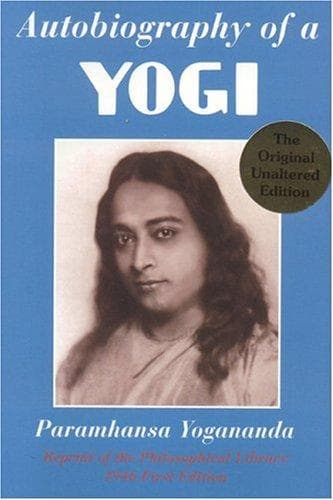
Yogananda, Paramahansa, 1893-1952; Yogis -- India -- Biography
{FN12-19} “Man in his waking state puts forth innumerable efforts
for experiencing sensual pleasures; when the entire group of sensory
organs is fatigued, he forgets even the pleasure on hand and goes
to sleep in order to enjoy rest in the soul, his own nature,”
Shankara, the great Vedantist, has written. “Ultra-sensual bliss
is thus extremely easy of attainment and is far superior to sense
delights which always end in disgust.”
{FN12-20} MARK 2:27.
{FN12-21} The UPANISHADS or VEDANTA (literally, “end of the Vedas”),
occur in certain parts of the VEDAS as essential summaries. The
UPANISHADS furnish the doctrinal basis of the Hindu religion. They
received the following tribute from Schopenhauer: “How entirely
does the UPANISHAD breathe throughout the holy spirit of the VEDAS!
How is everyone who has become familiar with that incomparable book
stirred by that spirit to the very depths of his soul! From every
sentence deep, original, and sublime thoughts arise, and the whole
is pervaded by a high and holy and earnest spirit. . . . The access
to the VEDAS by means of the UPANISHADS is in my eyes the greatest
privilege this century may claim before all previous centuries.”
{FN12-22} Commentaries. Shankara peerlessly expounded the UPANISHADS.
{FN12-23} PROVERBS 16:32.
CHAPTER: 13
THE SLEEPLESS SAINT
“Please permit me to go to the Himalayas. I hope in unbroken solitude
to achieve continuous divine communion.”
I actually once addressed these ungrateful words to my Master.
Seized by one of the unpredictable delusions which occasionally
assail the devotee, I felt a growing impatience with hermitage
duties and college studies. A feebly extenuating circumstance is
that my proposal was made when I had been only six months with Sri
Yukteswar. Not yet had I fully surveyed his towering stature.
“Many hillmen live in the Himalayas, yet possess no God-perception.”
My guru’s answer came slowly and simply. “Wisdom is better sought
from a man of realization than from an inert mountain.”
Ignoring Master’s plain hint that he, and not a hill, was my teacher,
I repeated my plea. Sri Yukteswar vouchsafed no reply. I took his
silence for consent, a precarious interpretation readily accepted
at one’s convenience.
In my Calcutta home that evening, I busied myself with travel
preparations. Tying a few articles inside a blanket, I remembered
a similar bundle, surreptitiously dropped from my attic window a
few years earlier. I wondered if this were to be another ill-starred
flight toward the Himalayas. The first time my spiritual elation had
been high; tonight conscience smote heavily at thought of leaving
my guru.
The following morning I sought out Behari Pundit, my Sanskrit
professor at Scottish Church College.
“Sir, you have told me of your friendship with a great disciple of
Lahiri Mahasaya. Please give me his address.”
Public-domain text, read in full here on John Shaqi.
Reviews
Reviews
No reviews yet
Be the first to share your thoughts on this work.
Elsewhere in the archive
Join the Discussion
Join the discussion
Sign in to leave a comment or review.
Sign InorCreate an account