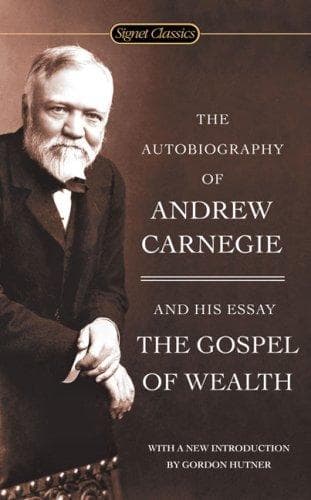
Carnegie, Andrew, 1835-1919; Industrialists -- United States -- Biography; Philanthropists -- United States -- Biography
While I was in the office Mr. Sampson, the financial editor of "The
Times," came in. I had an interview with him, well knowing that a few
words from him would go far in lifting the price of the bonds on the
Exchange. American securities had recently been fiercely attacked,
owing to the proceedings of Fisk and Gould in connection with the Erie
Railway Company, and their control of the judges in New York, who
seemed to do their bidding. I knew this would be handed out as an
objection, and therefore I met it at once. I called Mr. Sampson's
attention to the fact that the charter of the St. Louis Bridge Company
was from the National Government. In case of necessity appeal lay
directly to the Supreme Court of the United States, a body vying with
their own high tribunals. He said he would be delighted to give
prominence to this commendable feature. I described the bridge as a
toll-gate on the continental highway and this appeared to please him.
It was all plain and easy sailing, and when he left the office, Mr.
Morgan clapped me on the shoulder and said:
"Thank you, young man; you have raised the price of those bonds five
per cent this morning."
"All right, Mr. Morgan," I replied; "now show me how I can raise them
five per cent more for you."
The issue was a great success, and the money for the St. Louis Bridge
was obtained. I had a considerable margin of profit upon the
negotiation. This was my first financial negotiation with the bankers
of Europe. Mr. Pullman told me a few days later that Mr. Morgan at a
dinner party had told the telegraphic incident and predicted, "That
young man will be heard from."
After closing with Mr. Morgan, I visited my native town, Dunfermline,
and at that time made the town a gift of public baths. It is notable
largely because it was the first considerable gift I had ever made.
Long before that I had, at my Uncle Lauder's suggestion, sent a
subscription to the fund for the Wallace Monument on Stirling Heights
overlooking Bannockburn. It was not much, but I was then in the
telegraph office and it was considerable out of a revenue of thirty
dollars per month with family expenses staring us in the face. Mother
did not grudge it; on the contrary, she was a very proud woman that
her son's name was seen on the list of contributors, and her son felt
he was really beginning to be something of a man. Years afterward my
mother and I visited Stirling, and there unveiled, in the Wallace
Tower, a bust of Sir Walter Scott, which she had presented to the
monument committee. We had then made great progress, at least
financially, since the early subscription. But distribution had not
yet begun.[30] So far with me it had been the age of accumulation.
[Footnote 30: The ambitions of Mr. Carnegie at this time (1868) are
set forth in the following memorandum made by him. It has only
recently come to light:
_St. Nicholas Hotel, New York, December, 1868_
Public-domain text, read in full here on John Shaqi.
Reviews
Reviews
No reviews yet
Be the first to share your thoughts on this work.
Elsewhere in the archive
Join the Discussion
Join the discussion
Sign in to leave a comment or review.
Sign InorCreate an account