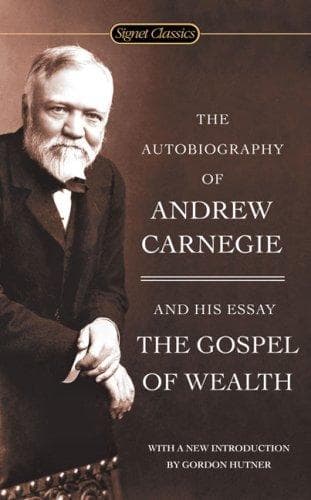
Carnegie, Andrew, 1835-1919; Industrialists -- United States -- Biography; Philanthropists -- United States -- Biography
The negotiations concerning two and a half millions of bonds for the
construction of the Omaha Bridge were successful, and as these bonds
had been purchased by persons connected with the Union Pacific before
I had anything to do with the company, it was for them and not for the
Union Pacific Company that the negotiations were conducted. This was
not explained to me by the director who talked with me before I left
for London. Unfortunately, when I returned to New York I found that
the entire proceeds of the bonds, including my profit, had been
appropriated by the parties to pay their own debts, and I was thus
beaten out of a handsome sum, and had to credit to profit and loss my
expenses and time. I had never before been cheated and found it out so
positively and so clearly. I saw that I was still young and had a good
deal to learn. Many men can be trusted, but a few need watching.
CHAPTER XII
BUSINESS NEGOTIATIONS
Complete success attended a negotiation which I conducted about this
time for Colonel William Phillips, president of the Allegheny Valley
Railway at Pittsburgh. One day the Colonel entered my New York office
and told me that he needed money badly, but that he could get no house
in America to entertain the idea of purchasing five millions of bonds
of his company although they were to be guaranteed by the Pennsylvania
Railroad Company. The old gentleman felt sure that he was being driven
from pillar to post by the bankers because they had agreed among
themselves to purchase the bonds only upon their own terms. He asked
ninety cents on the dollar for them, but this the bankers considered
preposterously high. Those were the days when Western railway bonds
were often sold to the bankers at eighty cents on the dollar.
Colonel Phillips said he had come to see whether I could not suggest
some way out of his difficulty. He had pressing need for two hundred
and fifty thousand dollars, and this Mr. Thomson, of the Pennsylvania
Railroad, could not give him. The Allegheny bonds were seven per
cents, but they were payable, not in gold, but in currency, in
America. They were therefore wholly unsuited for the foreign market.
But I knew that the Pennsylvania Railroad Company had a large amount
of Philadelphia and Erie Railroad six per cent gold bonds in its
treasury. It would be a most desirable exchange on its part, I
thought, to give these bonds for the seven per cent Allegheny bonds
which bore its guarantee.
Public-domain text, read in full here on John Shaqi.
Reviews
Reviews
No reviews yet
Be the first to share your thoughts on this work.
Elsewhere in the archive
Join the Discussion
Join the discussion
Sign in to leave a comment or review.
Sign InorCreate an account