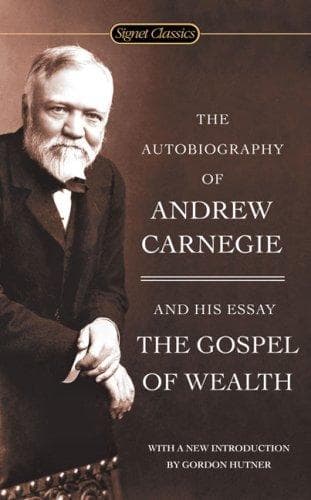
Carnegie, Andrew, 1835-1919; Industrialists -- United States -- Biography; Philanthropists -- United States -- Biography
"My father has cabled to ask whether you wish to sell out your
interest in that idea you gave him."
I said: "Yes, I do. In these days I will sell anything for money."
"Well," he said, "what would you take?"
I said I believed that a statement recently rendered to me showed that
there were already fifty thousand dollars to my credit, and I would
take sixty thousand. Next morning when I called Mr. Morgan handed me
checks for seventy thousand dollars.
"Mr. Carnegie," he said, "you were mistaken. You sold out for ten
thousand dollars less than the statement showed to your credit. It now
shows not fifty but sixty thousand to your credit, and the additional
ten makes seventy."
The payments were in two checks, one for sixty thousand dollars and
the other for the additional ten thousand. I handed him back the
ten-thousand-dollar check, saying:
"Well, that is something worthy of you. Will you please accept these
ten thousand with my best wishes?"
"No, thank you," he said, "I cannot do that."
Such acts, showing a nice sense of honorable understanding as against
mere legal rights, are not so uncommon in business as the uninitiated
might believe. And, after that, it is not to be wondered at if I
determined that so far as lay in my power neither Morgan, father or
son, nor their house, should suffer through me. They had in me
henceforth a firm friend.
[Illustration: JOHN PIERPONT MORGAN]
A great business is seldom if ever built up, except on lines of the
strictest integrity. A reputation for "cuteness" and sharp dealing is
fatal in great affairs. Not the letter of the law, but the spirit,
must be the rule. The standard of commercial morality is now very
high. A mistake made by any one in favor of the firm is corrected as
promptly as if the error were in favor of the other party. It is
essential to permanent success that a house should obtain a reputation
for being governed by what is fair rather than what is merely legal. A
rule which we adopted and adhered to has given greater returns than
one would believe possible, namely: always give the other party the
benefit of the doubt. This, of course, does not apply to the
speculative class. An entirely different atmosphere pervades that
world. Men are only gamblers there. Stock gambling and honorable
business are incompatible. In recent years it must be admitted that
the old-fashioned "banker," like Junius S. Morgan of London, has
become rare.
Public-domain text, read in full here on John Shaqi.
Reviews
Reviews
No reviews yet
Be the first to share your thoughts on this work.
Elsewhere in the archive
Join the Discussion
Join the discussion
Sign in to leave a comment or review.
Sign InorCreate an account