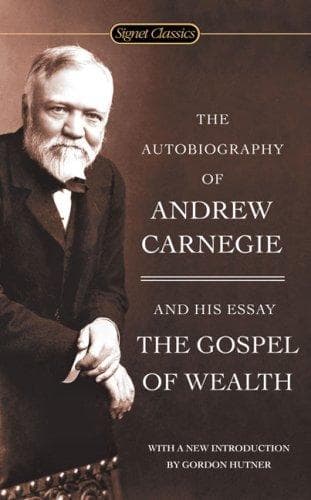
Carnegie, Andrew, 1835-1919; Industrialists -- United States -- Biography; Philanthropists -- United States -- Biography
It was not, however, all smooth sailing with our iron business. Years
of panic came at intervals. We had passed safely through the fall in
values following the war, when iron from nine cents per pound dropped
to three. Many failures occurred and our financial manager had his
time fully occupied in providing funds to meet emergencies. Among many
wrecks our firm stood with credit unimpaired. But the manufacture of
pig iron gave us more anxiety than any other department of our
business so far. The greatest service rendered us in this branch of
manufacturing was by Mr. Whitwell, of the celebrated Whitwell Brothers
of England, whose blast-furnace stoves were so generally used. Mr.
Whitwell was one of the best-known of the visitors who came to marvel
at the Lucy Furnace, and I laid the difficulty we then were
experiencing before him. He said immediately:
"That comes from the angle of the bell being wrong."
He explained how it should be changed. Our Mr. Kloman was slow to
believe this, but I urged that a small glass-model furnace and two
bells be made, one as the Lucy was and the other as Mr. Whitwell
advised it should be. This was done, and upon my next visit
experiments were made with each, the result being just as Mr. Whitwell
had foretold. Our bell distributed the large pieces to the sides of
the furnace, leaving the center a dense mass through which the blast
could only partially penetrate. The Whitwell bell threw the pieces to
the center leaving the circumference dense. This made all the
difference in the world. The Lucy's troubles were over.
What a kind, big, broad man was Mr. Whitwell, with no narrow jealousy,
no withholding his knowledge! We had in some departments learned new
things and were able to be of service to his firm in return. At all
events, after that everything we had was open to the Whitwells.
[To-day, as I write, I rejoice that one of the two still is with us
and that our friendship is still warm. He was my predecessor in the
presidency of the British Iron and Steel Institute.]
CHAPTER XIII
THE AGE OF STEEL
Looking back to-day it seems incredible that only forty years ago
(1870) chemistry in the United States was an almost unknown agent in
connection with the manufacture of pig iron. It was the agency, above
all others, most needful in the manufacture of iron and steel. The
blast-furnace manager of that day was usually a rude bully, generally
a foreigner, who in addition to his other acquirements was able to
knock down a man now and then as a lesson to the other unruly spirits
under him. He was supposed to diagnose the condition of the furnace by
instinct, to possess some almost supernatural power of divination,
like his congener in the country districts who was reputed to be able
to locate an oil well or water supply by means of a hazel rod. He was
a veritable quack doctor who applied whatever remedies occurred to him
for the troubles of his patient.
Public-domain text, read in full here on John Shaqi.
Reviews
Reviews
No reviews yet
Be the first to share your thoughts on this work.
Elsewhere in the archive
Join the Discussion
Join the discussion
Sign in to leave a comment or review.
Sign InorCreate an account