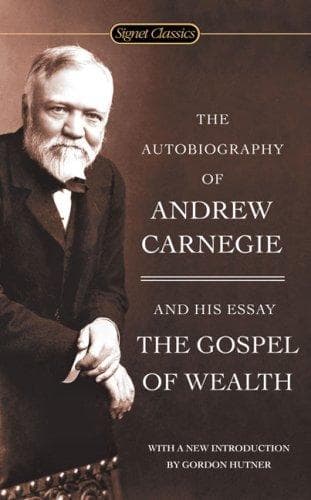
Carnegie, Andrew, 1835-1919; Industrialists -- United States -- Biography; Philanthropists -- United States -- Biography
William was a character. He never got over his German idioms and his
inverted English made his remarks very effective. Under his
superintendence the Union Iron Mills became a most profitable branch
of our business. He had overworked himself after a few years'
application and we decided to give him a trip to Europe. He came to
New York by way of Washington. When he called upon me in New York he
expressed himself as more anxious to return to Pittsburgh than to
revisit Germany. In ascending the Washington Monument he had seen the
Carnegie beams in the stairway and also at other points in public
buildings, and as he expressed it:
"It yust make me so broud dat I want to go right back and see dat
everyting is going right at de mill."
Early hours in the morning and late in the dark hours at night
William was in the mills. His life was there. He was among the first
of the young men we admitted to partnership, and the poor German lad
at his death was in receipt of an income, as I remember, of about
$50,000 a year, every cent of which was deserved. Stories about him
are many. At a dinner of our partners to celebrate the year's
business, short speeches were in order from every one. William summed
up his speech thus:
"What we haf to do, shentlemens, is to get brices up and costs down
and efery man _stand on his own bottom_." There was loud, prolonged,
and repeated laughter.
Captain Evans ("Fighting Bob") was at one time government inspector at
our mills. He was a severe one. William was sorely troubled at times
and finally offended the Captain, who complained of his behavior. We
tried to get William to realize the importance of pleasing a
government official. William's reply was:
"But he gomes in and smokes my cigars" (bold Captain! William reveled
in one-cent Wheeling tobies) "and then he goes and contems my iron.
What does you tinks of a man like dat? But I apologize and dreat him
right to-morrow."
The Captain was assured William had agreed to make due amends, but he
laughingly told us afterward that William's apology was:
"Vell, Captain, I hope you vas all right dis morning. I haf noting
against you, Captain," holding out his hand, which the Captain finally
took and all was well.
William once sold to our neighbor, the pioneer steel-maker of
Pittsburgh, James Park, a large lot of old rails which we could not
use. Mr. Park found them of a very bad quality. He made claims for
damages and William was told that he must go with Mr. Phipps to meet
Mr. Park and settle. Mr. Phipps went into Mr. Park's office, while
William took a look around the works in search of the condemned
material, which was nowhere to be seen. Well did William know where to
look. He finally entered the office, and before Mr. Park had time to
say a word William began:
Public-domain text, read in full here on John Shaqi.
Reviews
Reviews
No reviews yet
Be the first to share your thoughts on this work.
Elsewhere in the archive
Join the Discussion
Join the discussion
Sign in to leave a comment or review.
Sign InorCreate an account