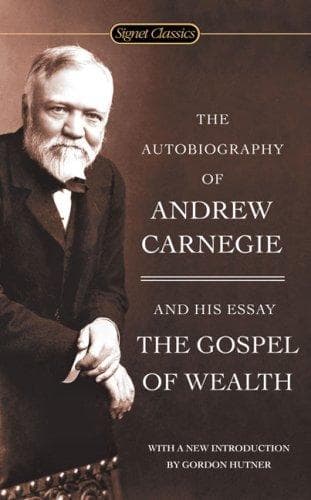
Carnegie, Andrew, 1835-1919; Industrialists -- United States -- Biography; Philanthropists -- United States -- Biography
The Captain was then quite young, spare and active, bearing traces of
his Welsh descent even in his stature, for he was quite short. He came
to us as a two-dollar-a-day mechanic from the neighboring works at
Johnstown. We soon saw that he was a character. Every movement told
it. He had volunteered as a private during the Civil War and carried
himself so finely that he became captain of a company which was never
known to flinch. Much of the success of the Edgar Thomson Works
belongs to this man.
In later years he declined an interest in the firm which would have
made him a millionaire. I told him one day that some of the young men
who had been given an interest were now making much more than he was
and we had voted to make him a partner. This entailed no financial
responsibility, as we always provided that the cost of the interest
given was payable only out of profits.
"No," he said, "I don't want to have my thoughts running on business.
I have enough trouble looking after these works. Just give me a h--l
of a salary if you think I'm worth it."
"All right, Captain, the salary of the President of the United States
is yours."
"That's the talk," said the little Welshman.[35]
[Footnote 35: The story is told that when Mr. Carnegie was selecting
his younger partners he one day sent for a young Scotsman, Alexander
R. Peacock, and asked him rather abruptly:
"Peacock, what would you give to be made a millionaire?"
"A liberal discount for cash, sir," was the answer.
He was a partner owning a two per cent interest when the Carnegie
Steel Company was merged into the United States Steel Corporation.]
Our competitors in steel were at first disposed to ignore us. Knowing
the difficulties they had in starting their own steel works, they
could not believe we would be ready to deliver rails for another year
and declined to recognize us as competitors. The price of steel rails
when we began was about seventy dollars per ton. We sent our agent
through the country with instructions to take orders at the best
prices he could obtain; and before our competitors knew it, we had
obtained a large number--quite sufficient to justify us in making a
start.
So perfect was the machinery, so admirable the plans, so skillful were
the men selected by Captain Jones, and so great a manager was he
himself, that our success was phenomenal. I think I place a unique
statement on record when I say that the result of the first month's
operations left a margin of profit of $11,000. It is also remarkable
that so perfect was our system of accounts that we knew the exact
amount of the profit. We had learned from experience in our iron works
what exact accounting meant. There is nothing more profitable than
clerks to check up each transfer of material from one department to
another in process of manufacture.
Public-domain text, read in full here on John Shaqi.
Reviews
Reviews
No reviews yet
Be the first to share your thoughts on this work.
Elsewhere in the archive
Join the Discussion
Join the discussion
Sign in to leave a comment or review.
Sign InorCreate an account