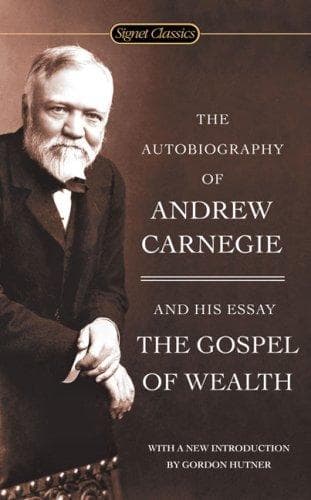
Carnegie, Andrew, 1835-1919; Industrialists -- United States -- Biography; Philanthropists -- United States -- Biography
The Freedom of my native town (Dunfermline) was conferred upon me July
12, 1877, the first Freedom and the greatest honor I ever received. I
was overwhelmed. Only two signatures upon the roll came between mine
and Sir Walter Scott's, who had been made a Burgess. My parents had
seen him one day sketching Dunfermline Abbey and often told me about
his appearance. My speech in reply to the Freedom was the subject of
much concern. I spoke to my Uncle Bailie Morrison, telling him I just
felt like saying so and so, as this really was in my heart. He was an
orator himself and he spoke words of wisdom to me then.
"Just say that, Andra; nothing like saying just what you really feel."
It was a lesson in public speaking which I took to heart. There is one
rule I might suggest for youthful orators. When you stand up before an
audience reflect that there are before you only men and women. You
should speak to them as you speak to other men and women in daily
intercourse. If you are not trying to be something different from
yourself, there is no more occasion for embarrassment than if you were
talking in your office to a party of your own people--none whatever.
It is trying to be other than one's self that unmans one. Be your own
natural self and go ahead. I once asked Colonel Ingersoll, the most
effective public speaker I ever heard, to what he attributed his
power. "Avoid elocutionists like snakes," he said, "and be yourself."
[Illustration: AN AMERICAN FOUR-IN-HAND IN BRITAIN]
I spoke again at Dunfermline, July 27, 1881, when my mother laid the
foundation stone there of the first free library building I ever gave.
My father was one of five weavers who founded the earliest library in
the town by opening their own books to their neighbors. Dunfermline
named the building I gave "Carnegie Library." The architect asked for
my coat of arms. I informed him I had none, but suggested that above
the door there might be carved a rising sun shedding its rays with the
motto: "Let there be light." This he adopted.
We had come up to Dunfermline with a coaching party. When walking
through England in the year 1867 with George Lauder and Harry Phipps I
had formed the idea of coaching from Brighton to Inverness with a
party of my dearest friends. The time had come for the long-promised
trip, and in the spring of 1881 we sailed from New York, a party of
eleven, to enjoy one of the happiest excursions of my life. It was one
of the holidays from business that kept me young and happy--worth all
the medicine in the world.
Public-domain text, read in full here on John Shaqi.
Reviews
Reviews
No reviews yet
Be the first to share your thoughts on this work.
Elsewhere in the archive
Join the Discussion
Join the discussion
Sign in to leave a comment or review.
Sign InorCreate an account