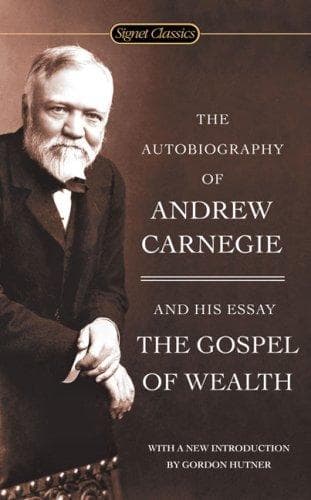
Carnegie, Andrew, 1835-1919; Industrialists -- United States -- Biography; Philanthropists -- United States -- Biography
I was the first stricken, upon returning from a visit in the East to
our cottage at Cresson Springs on top of the Alleghanies where my
mother and I spent our happy summers. I had been quite unwell for a
day or two before leaving New York. A physician being summoned, my
trouble was pronounced typhoid fever. Professor Dennis was called from
New York and he corroborated the diagnosis. An attendant physician and
trained nurse were provided at once. Soon after my mother broke down
and my brother in Pittsburgh also was reported ill.
I was despaired of, I was so low, and then my whole nature seemed to
change. I became reconciled, indulged in pleasing meditations, was
without the slightest pain. My mother's and brother's serious
condition had not been revealed to me, and when I was informed that
both had left me forever it seemed only natural that I should follow
them. We had never been separated; why should we be now? But it was
decreed otherwise.
I recovered slowly and the future began to occupy my thoughts. There
was only one ray of hope and comfort in it. Toward that my thoughts
always turned. For several years I had known Miss Louise Whitfield.
Her mother permitted her to ride with me in the Central Park. We were
both very fond of riding. Other young ladies were on my list. I had
fine horses and often rode in the Park and around New York with one or
the other of the circle. In the end the others all faded into ordinary
beings. Miss Whitfield remained alone as the perfect one beyond any I
had met. Finally I began to find and admit to myself that she stood
the supreme test I had applied to several fair ones in my time. She
alone did so of all I had ever known. I could recommend young men to
apply this test before offering themselves. If they can honestly
believe the following lines, as I did, then all is well:
"Full many a lady
I've eyed with best regard: for several virtues
Have I liked several women, never any
With so full soul, but some defect in her
Did quarrel with the noblest grace she owed,
And put it to the foil; but you, O you,
So perfect and so peerless are created
Of every creature's best."[38]
[Footnote 38: Ferdinand to Miranda in _The Tempest_.]
In my soul I could echo those very words. To-day, after twenty years
of life with her, if I could find stronger words I could truthfully
use them.
Public-domain text, read in full here on John Shaqi.
Reviews
Reviews
No reviews yet
Be the first to share your thoughts on this work.
Elsewhere in the archive
Join the Discussion
Join the discussion
Sign in to leave a comment or review.
Sign InorCreate an account