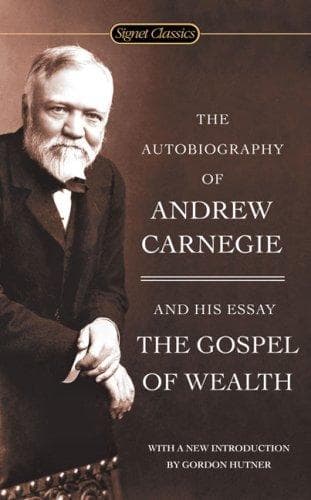
Carnegie, Andrew, 1835-1919; Industrialists -- United States -- Biography; Philanthropists -- United States -- Biography
I owe this vindication to Mr. Oscar Straus, who had read my articles
and speeches of early days upon labor questions, and who had quoted
these frequently to workmen. The two labor leaders of the Amalgamated
Union, White and Schaeffer from Pittsburgh, who were at this dinner,
were also able and anxious to enlighten their fellow-workmen members
of the Board as to my record with labor, and did not fail to do so.
A mass meeting of the workmen and their wives was afterwards held in
the Library Hall at Pittsburgh to greet me, and I addressed them from
both my head and my heart. The one sentence I remember, and always
shall, was to the effect that capital, labor, and employer were a
three-legged stool, none before or after the others, all equally
indispensable. Then came the cordial hand-shaking and all was well.
Having thus rejoined hands and hearts with our employees and their
wives, I felt that a great weight had been effectually lifted, but I
had had a terrible experience although thousands of miles from the
scene.
An incident flowing from the Homestead trouble is told by my friend,
Professor John C. Van Dyke, of Rutgers College.
In the spring of 1900, I went up from Guaymas, on the Gulf
of California, to the ranch of a friend at La Noria Verde,
thinking to have a week's shooting in the mountains of
Sonora. The ranch was far enough removed from civilization,
and I had expected meeting there only a few Mexicans and
many Yaqui Indians, but much to my surprise I found an
English-speaking man, who proved to be an American. I did
not have long to wait in order to find out what brought him
there, for he was very lonesome and disposed to talk. His
name was McLuckie, and up to 1892 he had been a skilled
mechanic in the employ of the Carnegie Steel Works at
Homestead. He was what was called a "top hand," received
large wages, was married, and at that time had a home and
considerable property. In addition, he had been honored by
his fellow-townsmen and had been made burgomaster of
Homestead.
When the strike of 1892 came McLuckie naturally sided with
the strikers, and in his capacity as burgomaster gave the
order to arrest the Pinkerton detectives who had come to
Homestead by steamer to protect the works and preserve
order. He believed he was fully justified in doing this. As
he explained it to me, the detectives were an armed force
invading his bailiwick, and he had a right to arrest and
disarm them. The order led to bloodshed, and the conflict
was begun in real earnest.
Public-domain text, read in full here on John Shaqi.
Reviews
Reviews
No reviews yet
Be the first to share your thoughts on this work.
Elsewhere in the archive
Join the Discussion
Join the discussion
Sign in to leave a comment or review.
Sign InorCreate an account