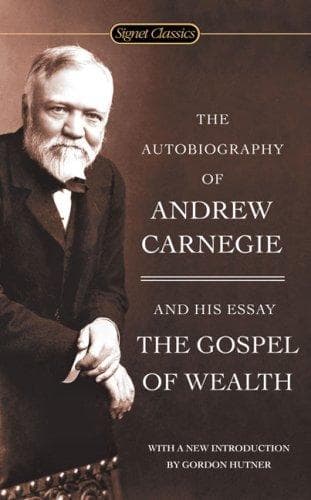
Carnegie, Andrew, 1835-1919; Industrialists -- United States -- Biography; Philanthropists -- United States -- Biography
I asked the superintendent to call together the three committees which
governed the works--not only the blast-furnace committee that was
alone involved, but the mill and the converting works committees as
well. They appeared and, of course, were received by me with great
courtesy, not because it was good policy to be courteous, but because
I have always enjoyed meeting our men. I am bound to say that the more
I know of working-men the higher I rate their virtues. But it is with
them as Barrie says with women: "Dootless the Lord made a' things
weel, but he left some michty queer kinks in women." They have their
prejudices and "red rags," which have to be respected, for the main
root of trouble is ignorance, not hostility. The committee sat in a
semicircle before me, all with their hats off, of course, as mine
was also; and really there was the appearance of a model assembly.
Addressing the chairman of the mill committee, I said:
"Mr. Mackay" (he was an old gentleman and wore spectacles), "have we
an agreement with you covering the remainder of the year?"
Taking the spectacles off slowly, and holding them in his hand, he
said:
"Yes, sir, you have, Mr. Carnegie, and you haven't got enough money to
make us break it either."
"There spoke the true American workman," I said. "I am proud of you."
"Mr. Johnson" (who was chairman of the rail converters' committee),
"have we a similar agreement with you?"
Mr. Johnson was a small, spare man; he spoke very deliberately:
"Mr. Carnegie, when an agreement is presented to me to sign, I read it
carefully, and if it don't suit me, I don't sign it, and if it does
suit me, I do sign it, and when I sign it I keep it."
"There again speaks the self-respecting American workman," I said.
Turning now to the chairman of the blast-furnaces committee, an
Irishman named Kelly, I addressed the same question to him:
"Mr. Kelly, have we an agreement with you covering the remainder of
this year?"
Mr. Kelly answered that he couldn't say exactly. There was a paper
sent round and he signed it, but didn't read it over carefully, and
didn't understand just what was in it. At this moment our
superintendent, Captain Jones, excellent manager, but impulsive,
exclaimed abruptly:
"Now, Mr. Kelly, you know I read that over twice and discussed it with
you!"
"Order, order, Captain! Mr. Kelly is entitled to give his explanation.
I sign many a paper that I do not read--documents our lawyers and
partners present to me to sign. Mr. Kelly states that he signed this
document under such circumstances and his statement must be received.
But, Mr. Kelly, I have always found that the best way is to carry out
the provisions of the agreement one signs carelessly and resolve to be
more careful next time. Would it not be better for you to continue
four months longer under this agreement, and then, when you sign the
next one, see that you understand it?"
There was no answer to this, and I arose and said:
Public-domain text, read in full here on John Shaqi.
Reviews
Reviews
No reviews yet
Be the first to share your thoughts on this work.
Elsewhere in the archive
Join the Discussion
Join the discussion
Sign in to leave a comment or review.
Sign InorCreate an account