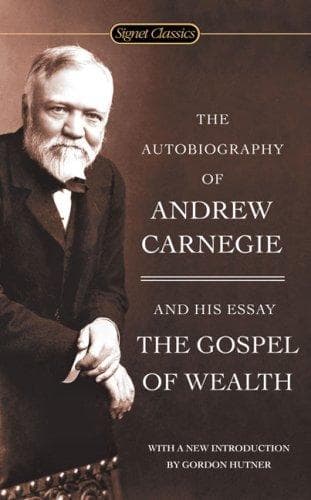
Carnegie, Andrew, 1835-1919; Industrialists -- United States -- Biography; Philanthropists -- United States -- Biography
So it was, but it was not by direct attack, but by a flank movement.
Had I not allowed the union officers to sign, they would have had a
grievance and an excuse for war. As it was, having allowed them to do
so, how could they refuse so simple a request as mine, that each free
and independent American citizen should also sign for himself. My
recollection is that as a matter of fact the officers of the union
never signed, but they may have done so. Why should they, if every
man's signature was required? Besides this, the workmen, knowing that
the union could do nothing for them when the scale was adopted,
neglected to pay dues and the union was deserted. We never heard of it
again. [That was in 1889, now twenty-seven years ago. The scale has
never been changed. The men would not change it if they could; it
works for their benefit, as I told them it would.]
Of all my services rendered to labor the introduction of the sliding
scale is chief. It is the solution of the capital and labor problem,
because it really makes them partners--alike in prosperity and
adversity. There was a yearly scale in operation in the Pittsburgh
district in the early years, but it is not a good plan because men and
employers at once begin preparing for a struggle which is almost
certain to come. It is far better for both employers and employed to
set no date for an agreed-upon scale to end. It should be subject to
six months' or a year's notice on either side, and in that way might
and probably would run on for years.
To show upon what trifles a contest between capital and labor may
turn, let me tell of two instances which were amicably settled by mere
incidents of seemingly little consequence. Once when I went out to
meet a men's committee, which had in our opinion made unfair demands,
I was informed that they were influenced by a man who secretly owned a
drinking saloon, although working in the mills. He was a great bully.
The sober, quiet workmen were afraid of him, and the drinking men were
his debtors. He was the real instigator of the movement.
We met in the usual friendly fashion. I was glad to see the men, many
of whom I had long known and could call by name. When we sat down at
the table the leader's seat was at one end and mine at the other. We
therefore faced each other. After I had laid our proposition before
the meeting, I saw the leader pick up his hat from the floor and
slowly put it on his head, intimating that he was about to depart.
Here was my chance.
"Sir, you are in the presence of gentlemen! Please be so good as to
take your hat off or leave the room!"
Public-domain text, read in full here on John Shaqi.
Reviews
Reviews
No reviews yet
Be the first to share your thoughts on this work.
Elsewhere in the archive
Join the Discussion
Join the discussion
Sign in to leave a comment or review.
Sign InorCreate an account