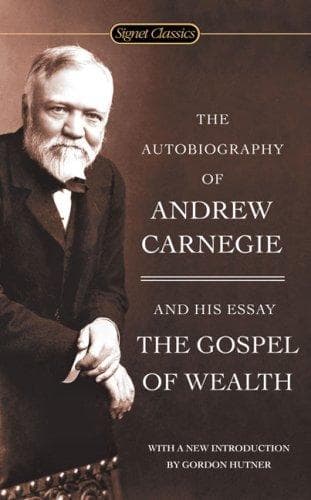
Carnegie, Andrew, 1835-1919; Industrialists -- United States -- Biography; Philanthropists -- United States -- Biography
He coached with us in 1880, I think, through Southern England--William
Black and Edwin A. Abbey being of the party. Approaching a pretty
village he asked me if the coach might stop there a few minutes. He
explained that this was the resting-place of his godfather, Bishop
Keble, and he should like to visit his grave. He continued:
"Ah, dear, dear Keble! I caused him much sorrow by my views upon
theological subjects, which caused me sorrow also, but notwithstanding
he was deeply grieved, dear friend as he was, he traveled to Oxford
and voted for me for Professor of English Poetry."
We walked to the quiet churchyard together. Matthew Arnold in silent
thought at the grave of Keble made upon me a lasting impression. Later
the subject of his theological views was referred to. He said they had
caused sorrow to his best friends.
"Mr. Gladstone once gave expression to his deep disappointment, or to
something like displeasure, saying I ought to have been a bishop. No
doubt my writings prevented my promotion, as well as grieved my
friends, but I could not help it. I had to express my views."
I remember well the sadness of tone with which these last words
were spoken, and how very slowly. They came as from the deep. He had
his message to deliver. Steadily has the age advanced to receive it.
His teachings pass almost uncensured to-day. If ever there was a
seriously religious man it was Matthew Arnold. No irreverent word ever
escaped his lips. In this he and Gladstone were equally above
reproach, and yet he had in one short sentence slain the supernatural.
"The case against miracles is closed. They do not happen."
He and his daughter, now Mrs. Whitridge, were our guests when in New
York in 1883, and also at our mountain home in the Alleghanies, so
that I saw a great deal, but not enough, of him. My mother and myself
drove him to the hall upon his first public appearance in New York.
Never was there a finer audience gathered. The lecture was not a
success, owing solely to his inability to speak well in public. He was
not heard. When we returned home his first words were:
"Well, what have you all to say? Tell me! Will I do as a lecturer?"
I was so keenly interested in his success that I did not hesitate to
tell him it would never do for him to go on unless he fitted himself
for public speaking. He must get an elocutionist to give him lessons
upon two or three points. I urged this so strongly that he consented
to do so. After we all had our say, he turned to my mother, saying:
"Now, dear Mrs. Carnegie, they have all given me their opinions, but I
wish to know what you have to say about my first night as a lecturer
in America."
Public-domain text, read in full here on John Shaqi.
Reviews
Reviews
No reviews yet
Be the first to share your thoughts on this work.
Elsewhere in the archive
Join the Discussion
Join the discussion
Sign in to leave a comment or review.
Sign InorCreate an account