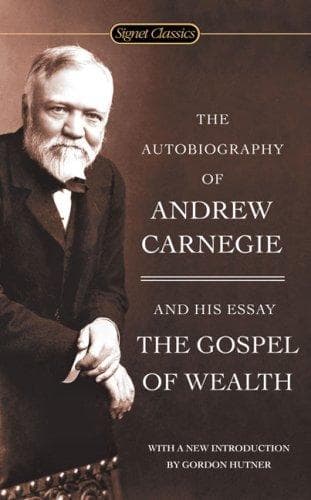
Carnegie, Andrew, 1835-1919; Industrialists -- United States -- Biography; Philanthropists -- United States -- Biography
Mr. Arnold was not prepared to enjoy Chicago, which had impressed him
as the headquarters of Philistinism. He was, however, surprised and
gratified at meeting with so much "culture and refinement." Before he
started he was curious to know what he should find most interesting. I
laughingly said that he would probably first be taken to see the most
wonderful sight there, which was said to be the slaughter houses, with
new machines so perfected that the hog driven in at one end came out
hams at the other before its squeal was out of one's ears. Then after
a pause he asked reflectively:
"But why should one go to slaughter houses, why should one hear hogs
squeal?" I could give no reason, so the matter rested.
Mr. Arnold's Old Testament favorite was certainly Isaiah: at least his
frequent quotations from that great poet, as he called him, led one to
this conclusion. I found in my tour around the world that the sacred
books of other religions had been stripped of the dross that had
necessarily accumulated around their legends. I remembered Mr. Arnold
saying that the Scriptures should be so dealt with. The gems from
Confucius and others which delight the world have been selected with
much care and appear as "collects." The disciple has not the
objectionable accretions of the ignorant past presented to him.
The more one thinks over the matter, the stronger one's opinion
becomes that the Christian will have to follow the Eastern example and
winnow the wheat from the chaff--worse than chaff, sometimes the
positively pernicious and even poisonous refuse. Burns, in the
"Cotter's Saturday Night," pictures the good man taking down the big
Bible for the evening service:
"He wales a portion with judicious care."
We should have those portions selected and use the selections only. In
this, and much besides, the man whom I am so thankful for having known
and am so favored as to call friend, has proved the true teacher in
advance of his age, the greatest poetic teacher in the domain of "the
future and its viewless things."
I took Arnold down from our summer home at Cresson in the Alleghanies
to see black, smoky Pittsburgh. In the path from the Edgar Thomson
Steel Works to the railway station there are two flights of steps to
the bridge across the railway, the second rather steep. When we had
ascended about three quarters of it he suddenly stopped to gain
breath. Leaning upon the rail and putting his hand upon his heart, he
said to me:
"Ah, this will some day do for me, as it did for my father."
I did not know then of the weakness of his heart, but I never forgot
this incident, and when not long after the sad news came of his sudden
death, after exertion in England endeavoring to evade an obstacle, it
came back to me with a great pang that our friend had foretold his
fate. Our loss was great. To no man I have known could Burns's epitaph
upon Tam Samson be more appropriately applied:
Public-domain text, read in full here on John Shaqi.
Reviews
Reviews
No reviews yet
Be the first to share your thoughts on this work.
Elsewhere in the archive
Join the Discussion
Join the discussion
Sign in to leave a comment or review.
Sign InorCreate an account