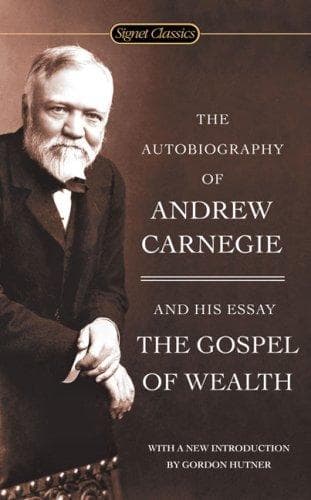
Carnegie, Andrew, 1835-1919; Industrialists -- United States -- Biography; Philanthropists -- United States -- Biography
This feeling already prevails in all the British colonies. The dear
old Motherland hen has ducks for chickens which give her much anxiety
breasting the waves, while she, alarmed, screams wildly from the
shore; but she will learn to swim also by and by.
In the autumn of 1905 Mrs. Carnegie and I attended the ceremony of
giving the Freedom of Dunfermline to our friend, Dr. John Ross,
chairman of the Carnegie Dunfermline Trust, foremost and most zealous
worker for the good of the town. Provost Macbeth in his speech
informed the audience that the honor was seldom conferred, that there
were only three living burgesses--one their member of Parliament, H.
Campbell-Bannerman, then Prime Minister; the Earl of Elgin of
Dunfermline, ex-Viceroy of India, then Colonial Secretary; and the
third myself. This seemed great company for me, so entirely out of the
running was I as regards official station.
The Earl of Elgin is the descendant of The Bruce. Their family vault
is in Dunfermline Abbey, where his great ancestor lies under the Abbey
bell. It has been noted how Secretary Stanton selected General Grant
as the one man in the party who could not possibly be the commander.
One would be very apt to make a similar mistake about the Earl. When
the Scottish Universities were to be reformed the Earl was second on
the committee. When the Conservative Government formed its Committee
upon the Boer War, the Earl, a Liberal, was appointed chairman. When
the decision of the House of Lords brought dire confusion upon the
United Free Church of Scotland, Lord Elgin was called upon as the
Chairman of Committee to settle the matter. Parliament embodied his
report in a bill, and again he was placed at the head to apply it.
When trustees for the Universities of Scotland Fund were to be
selected, I told Prime Minister Balfour I thought the Earl of Elgin as
a Dunfermline magnate could be induced to take the chairmanship. He
said I could not get a better man in Great Britain. So it has proved.
John Morley said to me one day afterwards, but before he had, as a
member of the Dunfermline Trust, experience of the chairman:
"I used to think Elgin about the most problematical public man in high
position I had ever met, but I now know him one of the ablest. Deeds,
not words; judgment, not talk."
Such the descendant of The Bruce to-day, the embodiment of modest
worth and wisdom combined.
Public-domain text, read in full here on John Shaqi.
Reviews
Reviews
No reviews yet
Be the first to share your thoughts on this work.
Elsewhere in the archive
Join the Discussion
Join the discussion
Sign in to leave a comment or review.
Sign InorCreate an account