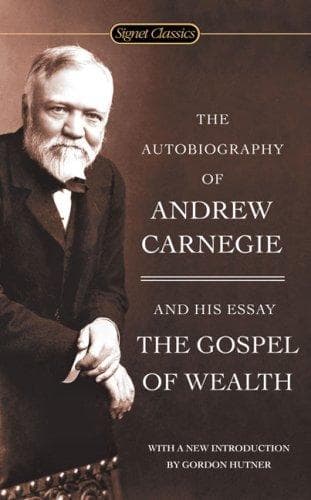
Carnegie, Andrew, 1835-1919; Industrialists -- United States -- Biography; Philanthropists -- United States -- Biography
The best people are on the councils of British towns, incorruptible,
public-spirited men, proud of and devoted to their homes. In the
United States progress is being made in this direction, but we are
here still far behind Britain. Nevertheless, people tend to settle
permanently in places as the country becomes thickly populated. We
shall develop the local patriot who is anxious to leave the place of
his birth a little better than he found it. It is only one generation
since the provostship of Scotch towns was generally reserved for one
of the local landlords belonging to the upper classes. That "the
Briton dearly loves a lord" is still true, but the love is rapidly
disappearing.
In Eastbourne, Kings-Lynn, Salisbury, Ilkeston, and many other ancient
towns, I found the mayor had risen from the ranks, and had generally
worked with his hands. The majority of the council were also of this
type. All gave their time gratuitously. It was a source of much
pleasure to me to know the provosts and leaders in council of so many
towns in Scotland and England, not forgetting Ireland where my Freedom
tour was equally attractive. Nothing could excel the reception
accorded me in Cork, Waterford, and Limerick. It was surprising to see
the welcome on flags expressed in the same Gaelic words, _Cead mille
failthe_ (meaning "a hundred thousand welcomes") as used by the
tenants of Skibo.
Nothing could have given me such insight into local public life and
patriotism in Britain as Freedom-taking, which otherwise might have
become irksome. I felt myself so much at home among the city chiefs
that the embarrassment of flags and crowds and people at the windows
along our route was easily met as part of the duty of the day, and
even the address of the chief magistrate usually furnished new phases
of life upon which I could dwell. The lady mayoresses were delightful
in all their pride and glory.
My conclusion is that the United Kingdom is better served by the
leading citizens of her municipalities, elected by popular vote, than
any other country far and away can possibly be; and that all is sound
to the core in that important branch of government. Parliament itself
could readily be constituted of a delegation of members from the town
councils without impairing its efficiency. Perhaps when the sufficient
payment of members is established, many of these will be found at
Westminster and that to the advantage of the Kingdom.
CHAPTER XXIV
GLADSTONE AND MORLEY
Mr. Gladstone paid my "American Four-in-Hand in Britain" quite a
compliment when Mrs. Carnegie and I were his guests at Hawarden in
April, 1892. He suggested one day that I should spend the morning with
him in his new library, while he arranged his books (which no one
except himself was ever allowed to touch), and we could converse. In
prowling about the shelves I found a unique volume and called out to
my host, then on top of a library ladder far from me handling heavy
volumes:
Public-domain text, read in full here on John Shaqi.
Reviews
Reviews
No reviews yet
Be the first to share your thoughts on this work.
Elsewhere in the archive
Join the Discussion
Join the discussion
Sign in to leave a comment or review.
Sign InorCreate an account