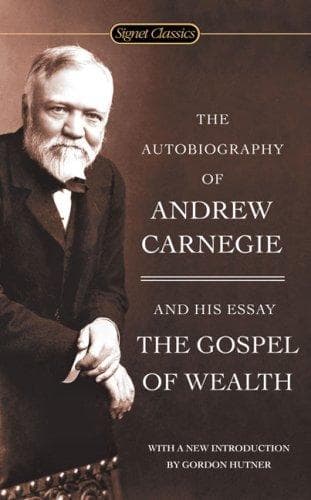
Carnegie, Andrew, 1835-1919; Industrialists -- United States -- Biography; Philanthropists -- United States -- Biography
I had to write Mr. Morley that I did not approve of the first Home
Rule Bill for reasons which I gave. When I met Mr. Gladstone he
expressed his regret at this and a full talk ensued. I objected to the
exclusion of the Irish members from Parliament as being a practical
separation. I said we should never have allowed the Southern States to
cease sending representatives to Washington.
"What would you have done if they refused?" he asked.
"Employed all the resources of civilization--first, stopped the
mails," I replied.
He paused and repeated:
"Stop the mails." He felt the paralysis this involved and was silent,
and changed the subject.
In answer to questions as to what I should do, I always pointed out
that America had many legislatures, but only one Congress. Britain
should follow her example, one Parliament and local legislatures (not
parliaments) for Ireland, Scotland, and Wales. These should be made
states like New York and Virginia. But as Britain has no Supreme
Court, as we have, to decide upon laws passed, not only by state
legislatures but by Congress, the judicial being the final authority
and not the political, Britain should have Parliament as the one
national final authority over Irish measures. Therefore, the acts of
the local legislature of Ireland should lie for three months'
continuous session upon the table of the House of Commons, subject to
adverse action of the House, but becoming operative unless
disapproved. The provision would be a dead letter unless improper
legislation were enacted, but if there were improper legislation, then
it would be salutary. The clause, I said, was needed to assure timid
people that no secession could arise.
Urging this view upon Mr. Morley afterwards, he told me this had been
proposed to Parnell, but rejected. Mr. Gladstone might then have said:
"Very well, this provision is not needed for myself and others who
think with me, but it is needed to enable us to carry Britain with us.
I am now unable to take up the question. The responsibility is yours."
One morning at Hawarden Mrs. Gladstone said:
"William tells me he has such extraordinary conversations with you."
These he had, no doubt. He had not often, if ever, heard the breezy
talk of a genuine republican and did not understand my inability to
conceive of different hereditary ranks. It seemed strange to me that
men should deliberately abandon the name given them by their parents,
and that name the parents' name. Especially amusing were the new
titles which required the old hereditary nobles much effort to refrain
from smiling at as they greeted the newly made peer who had perhaps
bought his title for ten thousand pounds, more or less, given to the
party fund.
Public-domain text, read in full here on John Shaqi.
Reviews
Reviews
No reviews yet
Be the first to share your thoughts on this work.
Elsewhere in the archive
Join the Discussion
Join the discussion
Sign in to leave a comment or review.
Sign InorCreate an account